








Pakistan, it seems, has stepped forward, selflessly offering to be part of US President Donald J. Trump's proposed International Stabilization Force (ISF) in the Gaza Strip. "We're very grateful to Pakistan for their offer to be part of it, or at least their offer to consider being a part of it," US Secretary of State Marco Rubio told reporters on December 20.
Under Trump's 20-point peace plan to end the Gaza war, sparked by the October 7, 2023 Hamas-led invasion of Israel, the primary goal of the ISF is to create a secure, demilitarized, and "terror-free" Gaza Strip that poses no threat to its neighbors. The ISF would accomplish this by enforcing the dismantlement of the Palestinian terror groups' military infrastructure, including tunnels and weapons-production facilities. The Trump plan, in addition, calls for establishing an "interfaith dialogue process will be established based on the values of tolerance and peaceful co-existence to try and change mindsets and narratives of Palestinians and Israelis by emphasizing the benefits that can be derived from peace."
If you want to disarm Hamas and other Palestinian terror groups and promote peace and coexistence between Palestinians and Israelis, Pakistan is the wrong choice.
Pakistan, which does not recognize Israel, has already made it clear that it is "not ready" to disarm Hamas. According to Pakistani Deputy Prime Minister and Foreign Minister Ishaq Dar:
"If the purpose of deploying an international stabilization force in Palestine is to disarm Hamas, then we are not ready for that, that's not our job. That is job of Palestinian law enforcement agencies....
"Prime Minister (Shebaz Sharif) had agreed in principle that we would also send forces [to Gaza], but we will decide only after knowing what the terms of reference, terms of action, and mandate will be... But as per my information, if it will include disarming Hamas, then even my Indonesian counterpart has formally expressed reservations."
Dar pointed out that Indonesia, whose government has offered 20,000 troops to the ISF, was also opposed to disarming Hamas.
Like most Arab and Islamic countries, Pakistan opposes disarming Hamas, possibly because it fears being accused by Arabs and Muslims of collaboration with Israel against a Palestinian "resistance" faction. Notably, not a single Arab or Islamic country has so far expressed readiness to take part in the disarmament of Hamas and other Palestinian terror groups in the Gaza Strip. The Arabs and Muslims are prepared to send troops to the Gaza Strip, but only to act as "peacekeepers" and "monitors," not to interfere with the ability of Hamas to rearm, regroup and attack Israel again at some convenient time in the future.
This, by complete coincidence, of course, is how Hamas also sees the role of the ISF.
Last week, Hamas leader Khalil al-Hayya, who leads a comfortable life residing in Qatar, said that the mission of the ISF should be limited just to sponsoring and monitoring the ceasefire agreement between his group and Israel. The international troops, he added, should be deployed only along the borders of the Gaza Strip, presumably to make sure that Israel does not prevent Hamas from rearming itself. International troops, he implied, were not wanted inside Gaza itself.
Pakistan's presence in the Gaza Strip will do the opposite of contributing to the deradicalization of the Palestinians there. It is worth noting that Pakistan voted against the United Nations Partition Plan for Palestine in 1947, and opposed the establishment of the State of Israel. The UN plan, accepted by Jewish leadership but rejected by Arab leaders, proposed dividing Mandatory Palestine into separate Arab and Jewish states. Hamas, as well, does not recognize Israel's right to exist and seeks to replace it with an Islamist state through violence and terrorism.
In 2020, Pakistan's Foreign Ministry stressed that recognition of Israel was still not under consideration. Pakistan has also come out against the Abraham Accords signed between Israel and some Arab and Islamic states under the sponsorship of the first and second Trump administrations. In June 2025, in fact,
"Foreign Minister Ishaq Dar... ruled out the possibility of Pakistan joining the Abraham Accords, stating that such a move would effectively mean abandoning the country's longstanding support for a two-state solution to the Palestinian conflict and recognising Israel."
In 2020, Pakistan's Ministry of Foreign Affairs released a statement that said:
"[T]he Prime Minister had clearly articulated Pakistan's position that unless a just settlement of the Palestine issue, satisfactory to the Palestinian people, was found, Pakistan could not recognize Israel. The Prime Minister had stressed that Pakistan's policy in this regard was rooted in Quaid-e-Azam's vision.
"The Prime Minister's remarks are an unequivocal reaffirmation of Pakistan's position on the subject, leaving no room for baseless speculation.
"For a just, comprehensive and lasting peace, Pakistan will continue to support a two-state solution... with pre-1967 borders and Al-Quds Al-Sharif as the capital of Palestine."
Pakistan's leaders, siding with South Africa in its prosecution of Israel in the International Criminal Court (ICC), to which Israel, incidentally, is not a party, have also accused Israel of war crimes and genocide.
Mushtaq Ahmad Khan, a member of Pakistan Senate from the Jamaat-e-Islami political party, said: "I think this is not normalization, this is an occupation." Describing Israel as an "illegal country," Khan said Israel's "hegemonic design and approach" was a threat to the people of the region, the Middle East, peace and the future."
In 2020, Junaid S. Ahmad, research fellow at Turkey's Center for Islam and Global Affairs and director of Pakistan's Center for Muslim World Studies, commented on Pakistan's policy:
"Moral imperatives, religious obligation, Islamic solidarity and national interests are all aligned to reject any move to recognize Tel Aviv. To do otherwise would be a betrayal of not only the Palestinians but the country of Pakistan, its people, its future – and would also be a rejection of our faith."
In November 2023, the South Asia Democratic Forum, a Brussels-based think tank, reported:
"It is not surprising that Pakistan – one of the greatest sponsors of cross-border terrorism and a hub of global Jihadist organisations – contributed to the military build-up of Hamas.... Hamas has its ideological roots in Pakistan. It is not only organically linked with Islamabad, but also deeply entrenched in its Jihadist patterns. In fact, before 9/11, the open 'publicising jihad was part of the Pakistan Army's image building exercise to present itself as fighting worldwide for the glory of Islam.' The country's government, military and intelligence celebration of the takeover of Kabul by the Taliban – hailed as a 'strategic victory' worthy of a parliamentary eulogy of Osama bin Laden by the then Prime Minister Imran Khan – underlines that Jihadism is an essential part of Pakistan's political culture."
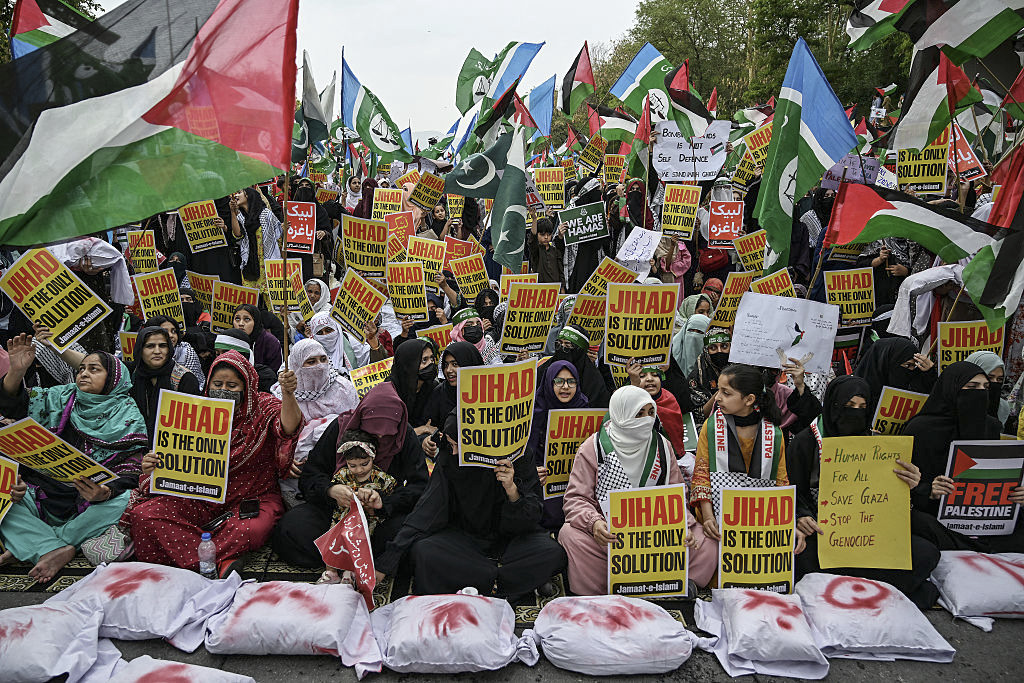
Unsurprisingly, last October thousands of Pakistanis took to the streets to voice support for Hamas and its leaders. The Turkish news agency Anadolu Ajansi reported:
"Waving Palestine flags, and carrying banners and placards inscribed with slogans like 'Down with Israel,' 'Long live Palestine,' and 'Hamas we are with you,' many children carried portraits of deceased Hamas leaders, including Ismail Hanneyeh and Yahya Al sinwar."
The demonstration was organized by Jamaat-e-Islami, Pakistan's mainstream religio-political party, whose leader called on the government to allow Hamas to open an office in Islamabad.
It is also worth noting that Pakistan's Islamic religious schools (madrassas) have been serving as fertile grounds for militant ideologies. These schools produce recruits for groups such as the Taliban and al-Qaeda, and create a Jihadi culture that fosters a strong anti-Western sentiment. As noted by the World Research of Political Science Journal,
"Some madrassas radicalize their pupils to the point where they are prepared to engage in violent acts that they perceive as being required by their religion. Madrassa students are occasionally instructed that it is their responsibility to put an end to any 'immoral' behavior and take up arms against any organization that veers from the straight path."
The Gaza Strip, which has been ruled by Hamas since 2007, already has its own Jihadi culture. Bringing Pakistanis into the Gaza Strip will only exacerbate the situation and strengthen this dangerous tide. The assumption that Pakistan will help disarm Hamas or contribute to the deradicalization of Palestinians in Gaza is spectacularly misguided. The Trump administration seriously needs to reconsider its plan to allow Pakistan, and all countries with ideologies such as these, to play any role in a future Gaza Strip.
Khaled Abu Toameh is an award-winning journalist based in Jerusalem.
 Harvey Radnor