








Pakistan's leadership unfortunately prefers Iran to the United States — not to mention Israel. Unfortunately, the US cannot trust Pakistan — especially in Gaza.
Pakistan has, to this day, never recognized Israel. Pakistan was also the first country to recognize the Islamic Republic of Iran after Ayatollah Ruhollah Khomeini established it in 1979. Iran had been the first country to recognize Pakistan upon its founding in 1947. Bilateral trade between the neighboring countries "stands at around US$ 2.8 billion."
Pakistan holds Major Non-NATO Ally (MNNA) status with the United States, a designation that grants it privileged access to military cooperation and equipment. Nevertheless, Pakistan has repeatedly demonstrated its unreliability as a strategic partner.
Pakistan officially portrays its relationship with Iran as one of fraternity and shared regional interests, and there is indeed significant convergence in their policy priorities:
Balochistan
Convergence is their shared approach toward Balochistan, where both governments perceive Baloch political activism as a direct threat to territorial integrity and state authority. In November 2024, the late Major General Hossein Salami, then commander of Iran's Islamic Revolutionary Guard Corps (IRGC), met with Pakistan's Army Chief Asim Munir, who oversees operations of the Inter-Services Intelligence (ISI). The two pledged enhanced cooperation against Baloch independence movements.
China
This alignment is further reinforced by shared economic interests with China. The China-Pakistan Economic Corridor (CPEC) constitutes one of the flagship components of China's Belt and Road Initiative (BRI). Iran wants integration into BRI and CPEC. China's Ambassador to Pakistan, Jiang Zaidong, said in August 2025 that the multibillion-dollar China-Pakistan Economic Corridor (CPEC) "would continue to be the 'backbone' of Pakistan's geo-economic transformation," mentioning that Pakistan can extend this corridor to Iran and beyond.
Officials from Iran and Pakistan have held talks about connecting CPEC to Iranian territory. One senior Iranian economic official said that "the establishment of a joint free trade zone and linking the China-Pakistan Economic Corridor (CPEC) through Iran to Russia and Europe could be put on the agenda of Tehran-Islamabad trade relations."
Iranian diplomats have publicly framed cooperation with Pakistan (and implicitly with Chinese connectivity frameworks) as part of a new "geo-economic order."
In October 2025, Iran's Ambassador to Pakistan, Reza Amiri Moghaddam, mentioned that Pakistan and Iran occupy a central position in the emerging geo-economic order. Delivering the keynote address at a forum titled "Pakistan-Iran Connectivity: For Two Countries and Two Continents," the ambassador said that Iran and Pakistan are "natural partners" in promoting regional integration.
Kashmir
Indian Major (ret.) Gaurav Arya stated in May 2025 about Pakistan-Iran relations:
"In 2017, Iran's Supreme Leader Ayatollah Ali Khamenei has on multiple occasions called for Islamic solidarity and support for Muslims in Kashmir, criticizing India and backing Pakistan's policies.
"Press TV, which is an Iranian television channel, and other Iranian state outlets routinely publish anti-India and Pro-Pakistan narratives on Kashmir. These narratives are very common in Iranian media.
"In fact, Press TV recalled that Imam Khomeini had a deep and personal affiliation with Kashmir. 'The unshakeable allegiance of Kashmiris to the ideals of the Islamic Revolution has to be seen in the context of the advocacy of their longstanding political struggle by both Imam Khomeini and his worthy successor, Ayatollah Seyyed Ali Khamenei,' Press TV stressed in a 2022 article, titled 'How Iran's Islamic revolution gained foothold in Kashmir.'"
Afghanistan
In 2014, Afghanistan's National Directorate of Security accused Pakistan's ISI and Iran's IRGC of jointly orchestrating clashes in Helmand province to advance their mutual interests, exploiting Afghanistan's post-election political instability. The agencies were described as "working together" to turn the area into a war zone, with Pakistan's ISI provoking violence in multiple provinces and the IRGC aligning to pursue border-related goals.
While not a direct IRGC-ISI partnership, both agencies supported the same proxy (the Taliban) as part of separate strategies to counter the pre-withdrawal U.S. presence in Afghanistan — effectively creating parallel alignments with similar effects on Afghan security dynamics. The IRGC-Quds Force provided weapons, training, and safe passage to Taliban fighters post-2001 as part of an effort to reduce U.S. regional influence. ISI provided sanctuary, logistics, training, and strategy to the Taliban insurgency during the U.S. deployment.
Twelve-Day War
The most recent example of Pakistan's close alliance with Iran emerged during the June 2025 Twelve-Day War — a direct armed conflict between Iran and a coalition of Israel and the United States. Throughout the hostilities, Pakistan aligned firmly with Iran, publicly expressing unqualified solidarity with Tehran.
During the war, IRGC General Mohsen Rezaei, a senior member of the National Security Council, announced that Pakistan had informed Iran it would retaliate with nuclear weapons against Israel if the latter were to use them against Iran. "Pakistan has stated that if Israel drops a nuclear bomb on Iran, it will drop a nuclear bomb of its own on Israel," Rezaei stated. The claim was later denied by Pakistan, but it shows how Iran feels close to Pakistan.
The supportive stance expanded to include Pakistan's Senate, which unanimously passed a resolution aimed at providing support to Iran. On June 13, 2025 — the day the war began — the Senate unanimously passed a resolution strongly condemning Israel's actions.
On June 14, 2025, Pakistani Prime Minister Shehbaz Sharif held a telephone conversation with Iranian President Masoud Pezeshkian. Sharif strongly condemned Israel's attacks as unprovoked aggression violating Iran's sovereignty, and reaffirmed Pakistan's "unwavering" and "resolute solidarity" with the Iranian government. Pezeshkian thanked Pakistan for its support, particularly at the UN Security Council, and highlighted the "brotherly" relations between the two countries.
Around June 22–23, 2025, following U.S. airstrikes on Iranian nuclear sites, Sharif again telephoned Pezeshkian to convey condolences for losses, condemn the U.S. actions as violations of international law, and reiterate Pakistan's solidarity.
On June 30, 2025, Pakistan's Chief of Army Staff, Field Marshal Asim Munir, received a call from Iran's top military commander, Major General Abdolrahim Mousavi, thanking him for his support during the war. Mousavi praised Islamabad's "courageous stance" during the crisis and thanked the people of Pakistan for their "bold positions" in condemning "what he called" unprovoked attacks by the "Zionist regime." Mousavi said that U.S. President Donald Trump "spared no effort in assisting the Zionist regime" by attacking Iran's civilian nuclear facilities. Munir told his counterpart that Pakistan valued its enduring ties with Iran.
Throughout the hostilities, Pakistan aligned firmly with Iran, publicly expressing unqualified solidarity with Tehran. This alignment continued and intensified in the aftermath of the conflict. Pezeshkian visited Pakistan on August 2-3, 2025 — his first official foreign trip after the war. Officials, think tanks and media in both countries widely hailed the visit as a major success, highlighting ambitions to raise annual bilateral trade.
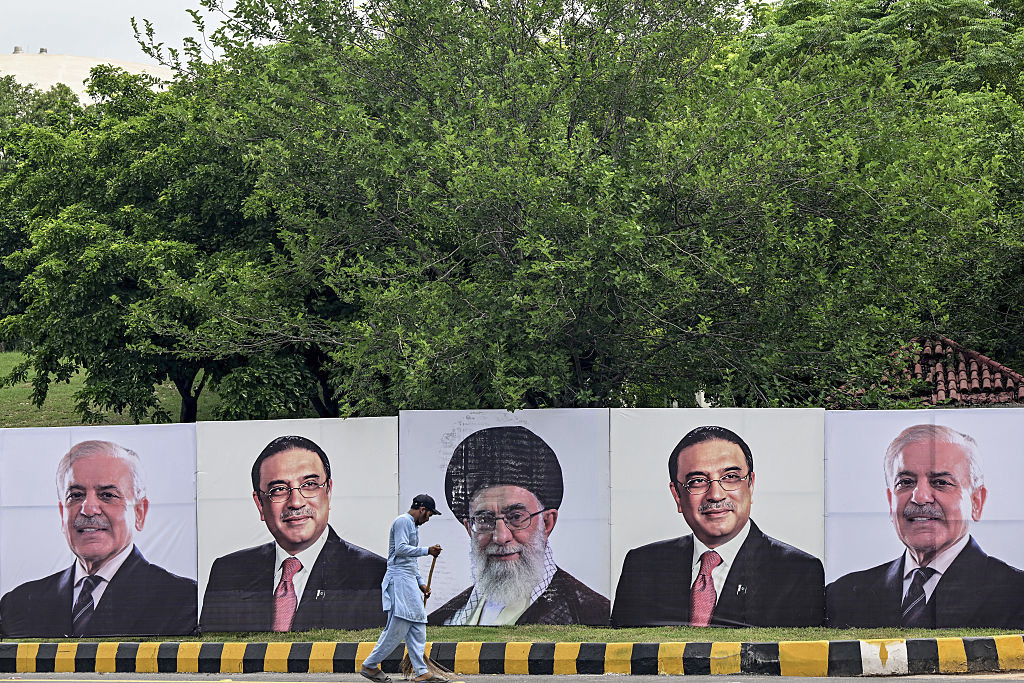
The streets of Islamabad were festooned with Pakistani and Iranian flags, along with large posters celebrating the friendship between the two nations. Prominent displays featuring portraits of Sharif, Pezeshkian, Khamenei and Pakistani President Asif Ali Zardari filled the cityscape. One notable poster on a main road carried the slogan: "Long live Pak-Iran friendship and brotherhood." Along the highway from the airport to the capital, banners welcomed the Iranian president.
During his visit, Pezeshkian repeatedly thanked Pakistan for its "firm," "heartening," and "unwavering" support throughout the conflict, describing it as evidence of the "deep bond" and "brotherly" relations between the two nations. Iranian state media amplified this gratitude, framing Pakistan's diplomatic stance as principled solidarity.
Pezeshkian and his delegation met Pakistan's top civilian and military leaders. During bilateral meetings, Iranian and Pakistani representatives reviewed multiple aspects of their relations, including "brotherly ties" as well as religious and cultural links, and engaged in wide-ranging discussions to further strengthen cooperation.
According to an official statement, Sharif said the two sides expressed a strong desire to raise bilateral trade to $10 billion at the earliest. The announcement coincided with the signing of 12 agreements and memoranda of understanding for various sectors, including technology and innovation.
Addressing a joint press briefing, Sharif condemned Israel's June 13 attack on Iran's nuclear facilities, stating:
"Israel, without any rhyme or reason, unleashed aggression against Iran, which was not only strongly condemned by the government of Pakistan but by the entire 240 million Pakistani people, as there was no reason for Israel to stoke war."
Sharif also expressed condolences over the "martyrdom" of Iranian generals and scientists. He praised the Iranian leadership for their "courage" and "wisdom" in responding to Israeli "aggression," noting that Iranian forces "successfully" challenged Israel's defense systems. Sharif reaffirmed Pakistan's principled support for Iran's "right" to pursue a nuclear program.
According to a statement from the Zardari's office, Pakistan and Iran "reaffirmed their commitment to further broaden bilateral cooperation in diverse fields" and emphasized the importance of strengthening ties across mutually beneficial areas. Zardari highlighted the "brotherly" relations between the two countries, rooted in shared religion, culture, and mutual respect. He then condemned the "Israeli aggression" against Iran and lauded the "bravery" of Iran during the recent 12-day war. Zardari expressed hope that Pezeshkian's visit would further solidify "brotherly ties" between Pakistan and Iran.
Zardari also thanked Khamenei for his "consistent support" for Pakistan regarding the Kashmir issue and its stance toward India.
Pakistani Foreign Minister Ishaq Dar reiterated Islamabad's commitment to maintaining "brotherly ties" with Iran, while Commerce Minister Jam Kamal emphasized the need to accelerate trade, remove border bottlenecks, and build trust-based partnerships across priority sectors. Further underscoring Islamabad's position, Kamal described Iran's performance in the war as a "triumph" over Israel and the United States, declaring that Iran stood as the "crown of the Islamic Ummah" and that its actions were a source of immense pride for Muslims worldwide.
Notably, Pezeshkian met with Field Marshal Munir, a central figure in the country's leadership. The two had previously met in May during a Pakistani state visit to Tehran, where Munir also held talks with senior Iranian military officials.
These developments, coming just weeks after a conflict in which the United States and Israel directly attacked Iranian targets, highlight Pakistan's consistent pattern of prioritizing regional and ideological ties with Tehran over its strategic commitments to Washington. As a recipient of MNNA privileges, Pakistan should not be regarded as a dependable ally, but as an extremely problematic partner whose privileged status warrants serious reconsideration.
 Jagdish N. Singh