








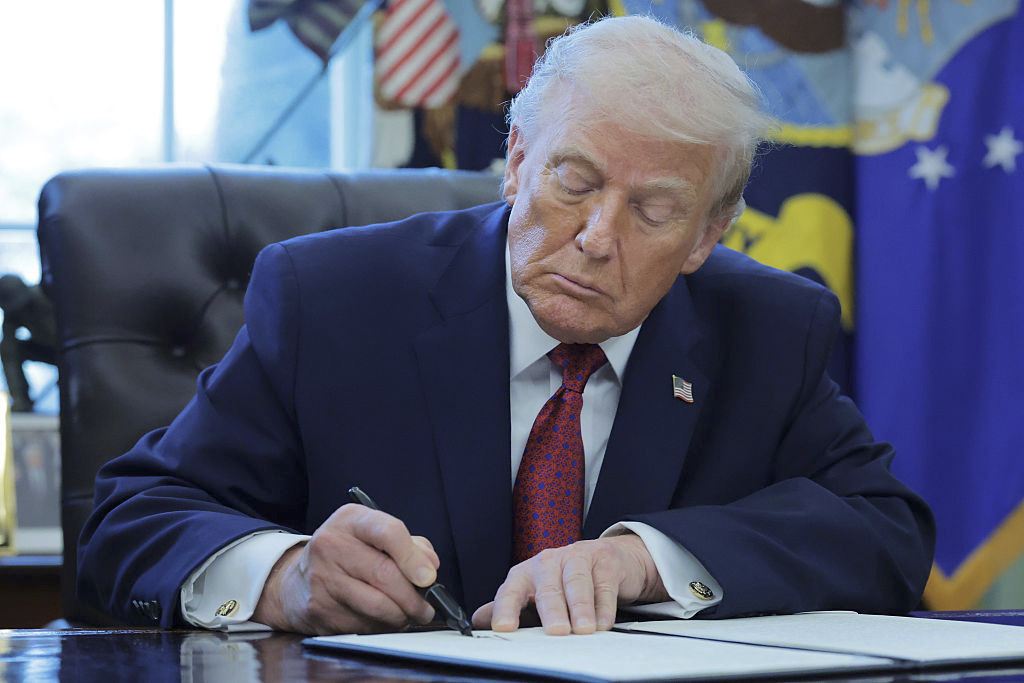
On November 24, 2025, U.S. President Donald J. Trump signed an executive order initiating a formal process to designate certain chapters of the Muslim Brotherhood as Foreign Terrorist Organizations and Specially Designated Global Terrorists. The order directs the Secretaries of State and Treasury to assess Muslim Brotherhood chapters in countries such as Egypt, Jordan, and Lebanon and take action under U.S. counterterrorism laws to deprive them of capabilities and resources — a move the executive order explicitly tied to national security priorities after the Hamas invasion of Israel on October 7, 2023 and its aftermath throughout the West. The order also sets a rapid timetable for recommendations on specific chapters.
Trump's executive order represents the most serious American effort in decades to confront Islamist political networks that, in Washington, had long been considered merely political differences rather than lethal security threats.
Across the Atlantic, however, the response to the same ideological current could not have been more different. In the European Union and many of its major capitals, political Islam — often embodied by Muslim Brotherhood-linked organizations — remains part of an approach for a larger "dialogue with Islamists". Can you imagine a "dialogue with Bolsheviks" or a "dialogue with the Third Reich"? Muslim extremists are being treated as a legitimate voice within civil society and political discourse. European policymakers have generally rejected hard designations, instead engaging extremist Muslim networks as stakeholders in "multicultural" governance. This contrast between Washington's confrontational stance and Brussels's engagement reflects a deep strategic divergence in how the West perceives political Islam.
The United States under the Trump administration frames the Muslim Brotherhood not as a partner in political reform but as a threat to national security. The November 2025 executive order emphasizes the Muslim Brotherhood's ties to terrorist activities, including support for Hamas and other terrorist organizations. Trump's directive instructs the administration to compile evidence for designations that could criminalize material support and curtail international operations of Muslim Brotherhood branches.
The president's moves follow years of debate within the U.S. government and Congress over whether or not the Muslim Brotherhood qualifies as a terrorist organization. Historically, U.S. administrations differentiated between violent jihadist groups — such as al-Qaeda and ISIS — and Islamist political movements such as the Muslim Brotherhood, which often participated in elections or civil society. But the combination of global Islamist violence and the Muslim Brotherhood's network of affiliates has shifted the American calculus toward confrontation. In parallel, new efforts in the 119th Congress have again pushed for statutory designation frameworks.
By contrast, the European Union has taken a far more cautious, at times permissive, approach, apparently preferring to regard Islamic extremists as potential voters. Brussels and member-state capitals have engaged with Muslim Brotherhood-linked networks through funding, inclusion in civil society consultations, and incorporation into multicultural policy initiatives. The Forum of European Muslim Youth and Student Organisations, for instance, represents a pan-European network active in EU political spaces and has been accused in some reports of links to the Muslim Brotherhood, although it denies organizational ties.
The structural presence of Muslim Brotherhood-affiliated networks in Europe extends beyond student organizations. The Federation of Islamic Organizations in Europe, founded in 1989 and headquartered in Brussels, serves as an umbrella for dozens of Islamic groups and has acted as a recognized interlocutor with European institutions. While it portrays itself as representing mainstream Muslim interests, academic and policy research has highlighted its foundational ties to the Muslim Brotherhood and transnational Islamist ideology.
This European policy of "dialogue" stems from a broad belief that incorporating "diverse" voices into social and political frameworks diminishes radicalization. Critics, however, argue that engaging groups with ideological linkages to transnational Islamism normalizes political currents that reject liberal European values, and relativizes extremism. In effect, this approach has permitted Islamist organizations to embed themselves in cultural and institutional networks, from youth forums to consultation processes for public policy.
In Belgium and especially Brussels — the seat of the EU — this dynamic is especially visible. Research presented in the European Parliament documents substantial funding streams from EU programs to organizations linked to Muslim Brotherhood networks, prompting alarm among some lawmakers about the integrity of taxpayer funds. These groups have not only received public money but have also been invited into policy dialogues and civil society advisory roles, a situation that would be unthinkable under Trump's counter-Islamist doctrine.
France offers a microcosm of the broader European dilemma. A government-commissioned report in 2025 alleged that the Muslim Brotherhood's networks have quietly expanded influence through schools, mosques, and local NGOs while masking ideological aims under the guise of integration and social services. The report prompted French President Emmanuel Macron to convene senior ministers to discuss strategies for responding to what it described as a long-term challenge to France's secular republican values. Yet even this steely assessment in France was met with pushback from civil liberties advocates and some academics, who questioned the evidence and warned against "stigmatizing" Muslim communities. Other critics of the report argued that labeling civil society engagement as Islamist penetration risked alienating moderate voices and inflaming social tensions.
This conflict between security concerns and inclusive governance captures the broader European struggle with political Islam.
Germany, too, reflects the complexity of Europe's approach. The Islamic Community of Germany (IGD), associated with the Federation of Islamic Organizations in Europe, has been recognized by domestic security services as a central organization for Muslim Brotherhood adherents in the country. Nevertheless, it operates openly within Germany's pluralist framework, illustrating how European institutions can tolerate intolerant Islamist networks within civil society while still claiming to uphold values of freedom and association.
In Sweden, reactions to the French report on the influence of the Muslim Brotherhood illustrate how domestic politics intersect with Europe's broader policy on Islamism. Sweden's Employment and Integration Minister Mats Persson responded by convening a "group of experts" to assess extremist Muslim influence, but also faced fierce criticism from Social Democratic leaders who dismissed the allegations against the Muslim Brotherhood as politically motivated, reflecting a deep divide over how to treat political Islam.
Across Europe, extremist Muslim organizations have also established strong youth and educational networks. Reports identify associations — some linked to the Muslim Brotherhood — that operate schools, youth programs, and cultural centers. In France alone, hundreds of such associations, including mosques and educational institutions, have been identified as connected with Muslim Brotherhood ideology, revealing the depth of the movement's entrenchment within civic structures.
The Muslim Brotherhood presence within civic structures is not incidental. Analysts note that its affiliate groups often employ "entryism," which is defined as:
"[T]he tactic pursued by extremist parties of gaining power through covertly entering more moderate, electorally successful, parties. Within those parties they maintain a distinct organization while publicly denying the existence of a 'party within the party.'"
Basically, entryism enables Islamists to gain influence within official institutions, shape public discourse, and normalize extremist Muslim thinking over decades. The West ends up assimilating into Islam, rather than the other way around.
Rather than confronting liberal democratic values, these "entryist" actors advocate for "reinterpretations" that often blur the lines between religious freedom and political Islam. Critics argue that Europe's engagement with Muslim Brotherhood networks has consequences beyond domestic politics. When civil institutions mingle with movements supportive of groups such as Hamas — itself the Palestinian branch of the Muslim Brotherhood — it undermines the West's unified stance against extremist ideologies. This division is particularly acute in debates over Israel, where EU indecision and ambiguous positions on political Islam -- accompanied by well-funded agitators -- have fueled anti-Israel agitation and radicalization among young Muslims in European cities.
Across the continent, cities such as Paris, Berlin, and Brussels have become flashpoints for this debate. In Paris, an official report highlighted the infiltration of Muslim Brotherhood-linked institutions into educational and religious spheres, raising concerns about parallel societal structures. In Germany, the Islamic Community of Germany's embedded network of mosques and associations underlines how Islamist influence can operate comfortably within Western democratic frameworks without triggering decisive state action. In Brussels, EU funding for Muslim Brotherhood-linked NGOs continues despite parliamentary scrutiny.
Contrast this with the Trump administration's doctrine, which treats ideological and organizational ties with political Islam not as components of civic pluralism but as security threats. Many Muslims in the West, of course, just want an opportunity for a better life, but they are not the ones driving the extremist Muslim train. The agenda, according to Islam itself, consists of sharing Allah's gift of Islam (Dar Al Islam, the "Abode of Islam") with the rest of the world (the Dar al Harb, the "Abode of War," those who have yet to submit to Islam) -- either by infiltration or force. Finally – when everyone in the world has submitted to Islam, whether they wanted to or not -- then there will be "peace." This, evidently, is when the world will enjoy "the Religion of Peace."
By initiating the designation process for Muslim Brotherhood chapters as terrorist entities, Trump is reshaping the strategic conversation — prioritizing national security and counterterrorism over the mirage of "accommodation" and "dialogue."
This divergence between Europe and the US reveals a deeper philosophical split in the West's understanding of political Islam. Europe's framework emphasizes integration, multiculturalism, and engagement, often at the expense of confronting underlying extremist ideological currents. In doing so, it assumes that political Islam can be moderated through participation and dialogue within existing democratic institutions. By contrast, the Trump approach assumes that certain ideological currents are incompatible with liberal democratic values when they support or facilitate extremist violence, destabilization, or anti-Western objectives. The push to treat Muslim Brotherhood chapters as terrorist entities follows this logic, seeking to disrupt networks that are seen as perpetuating radicalization and undermining security interests.
The result is a West that now follows two opposite paths. On one path, the United States under the Trump administration is moving toward clarity and confrontation, willing to codify ideological enemies and remove them from the political landscape. On the other path, Europe continues its policy of engagement, accommodation and submission, risk-balancing between wished-for civic inclusion and ideological risk. This split only serves to impede counterterrorism and jeopardize the West.
Pierre Rehov, who holds a law degree from Paris-Assas, is a French reporter, novelist and documentary filmmaker. He is the author of six novels, including "Beyond Red Lines", " The Third Testament" and "Red Eden", translated from French. His latest essay on the aftermath of the October 7 massacre " 7 octobre - La riposte " became a bestseller in France.As a filmmaker, he has produced and directed 17 documentaries, many photographed at high risk in Middle Eastern war zones, and focusing on terrorism, media bias, and the persecution of Christians. His latest documentary, "Pogrom(s)" highlights the context of ancient Jew hatred within Muslim civilization as the main force behind the October 7 massacre.
 bert33