








US President Donald J. Trump's Gulf Arab allies, according to the New York Times, oppose an American strike on Iran primarily out of fear of regional instability and the possible damage to economies, tourism, and domestic security.
While this explanation may sound credible on the surface, a deeper and far more uncomfortable reality is that for several of these regimes, the real danger is not Iran's collapse, but an ideological exposure that could follow decisive American action, as well as concern about Israel becoming more prominent in the region.
A serious confrontation with Iran would not only reshape the regional balance of power; it would also force a number of Arab states to clarify positions that for decades they have fought to keep ambiguous.
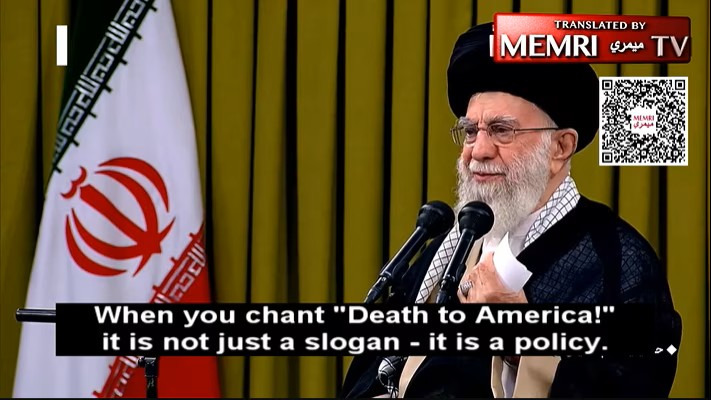
Iran, since its 1979 Islamic Revolution, is not merely a rival or destabilizing neighbor. It is the ideological and operational core of modern Islamist warfare in the Middle East. Since 1979, Tehran has armed, funded, trained, and coordinated proxy organizations with the explicit aim of undermining Western influence. "Death to America," Ayatollah Ali Khamenei announced in 2023, "is not just a slogan, it is a policy." For decades, Iran has also been encircling Israel in a "ring of fire" the better to destroy it.
Hezbollah in Lebanon; Hamas and Palestinian Islamic Jihad in Gaza; Shiite militias in Iraq and Syria, and the Houthis in Yemen are not independent actors pursuing local grievances. They are integral components of a coherent Iranian strategy, backed by Russia and China, aimed at expanding Islamist Iran's influence in the region by force; destabilizing sovereign states, and eroding the regional order from within. This strategy is not reactive; it is doctrinal.
Trump's Iran policy, after years of hesitant US engagement at best, has consistently combined economic pressure and military deterrence, with limited diplomatic patience, to restore America's international credibility.
Trump's restoration of credibility has apparently unsettled not only Iran's regime, but also some of Washington's supposed regional allies, who have grown accustomed to maneuvering Washington when desirable. Some, such as Qatar, have built fancied empires by never committing to any side and instead playing every side. Just as much blame, however, must go to those leaders in the Middle East and Europe who agreed to be played.
What many have largely avoided addressing is the extent to which some governments, such as Qatar's and Turkey's -- which host American military bases -- benefit from U.S. security guarantees.
While publicly Qatar and Turkey affirm their commitment to "stability", at the same time they zealously set about destabilizing half the planet by funding, promoting, and even training Islamist terror networks (such as here, here, here, here and here) that presumably serve their own strategic interests. To Western audiences, they speak the language of moderation, while churning up grievance narratives and ideological victimhood at home.
A decisive confrontation with Iran might shatter the carefully maintained duplicity that these countries have so tenderly nurtured for decades.
Qatar, for instance, presents itself as a neutral mediator, a champion of dialogue, and a facilitator of regional diplomacy, while in practice, for years, Qatar has provided safe haven, financial channels, and political legitimacy to just about every Islamic terrorist group. Hamas's senior leaders have been welcome to live in Qatar as safe and comfortable billionaires while directing their terrorist operations elsewhere.
According to Udi Levy, a former senior official of Israel's Mossad spy agency who dealt with economic warfare against terrorist organizations:
"Qatar is at the top of funding terrorism worldwide, even more than Iran... Qatar transferred funds through various channels, primarily via their largest foundation, Charai, which is one of the largest funding sources for terrorist organizations in the world."
Qatar's state-owned media empire, Al -Jazeera, consistently amplifies Islamist narratives, demonizes Israel, and undermines moderate Arab governments, all while projecting an image of supposed neutrality. In fact, by its own admission, it was Qatar that whipped up and catalyzed the entire disruptive "Arab Spring" that begin in 2010.
When Qatar is not acting out its central role in sustaining this Islamist terrorist ecosystem, an absent decoy to deflect attention, such as the Iranian regime, could redirect scrutiny toward Qatar even further.
Turkey, looking forward rather than backward, appears to agree with that assessment. Turkey, doubtless, shares the same point of view. It appears to be using its proxy, Syria -- under the interim presidency of former al-Qaeda leader Ahmed al-Sharaa -- and a place on Trump's alleged "Board of Peace " in Gaza, eventually to pincer Israel in the middle.
Under President Recep Tayyip Erdoğan, who regularly uses jihadist and anti-Israel rhetoric, Turkey abandoned what was left of Mustafa Kemal Ataturk's secular legacy in favor of overtly Islamist, neo-Ottoman goals. "The mosques are our barracks, the domes our helmets, the minarets our bayonets and the faithful our soldiers," Erdogan once recited.
Under Erdogan's rule, Turkey also hosts Hamas operatives, offers political cover to Islamist causes, and has dispatched armed flotillas, built 31 new warships, threatened Greece, and has been doing his utmost to acquire American F-35 stealth fighter jets.
While Turkey competes with Iran in certain arenas, it also benefits from Iran's role as a regional spoiler that distracts attention from Erdogan's own neo-Ottoman ambitions. A serious weakening of Iran would, by removing this diversionary decoy, expose Turkey's broader regional agenda in Syria and Gaza with greater visibility.
Saudi Arabia, by contrast, has suffered direct attacks from Iranian-backed forces and has legitimate reasons to fear aggression from Iran, which for decades appears to have had its acquisitive eyes on the kingdom's oil fields as well as its guardianship of Islam's two holiest sites: the pilgrimage Kaaba stone and its surrounding mosque in Mecca, and the Prophet's Mosque in Medina.
Saudi Arabia and Iran are not partners; they are fierce rivals and competitors. Saudi Crown Prince Mohammed bin Salman once prioritized domestic reform, economic diversification, and social transformation – while, in recent weeks, viciously turning against Israel "even more than al-Jazeera."
The United Arab Emirates, under the exceptional, trailblazing leadership of its president, Sheikh Mohamed bin Zayed Al Nahyan, has offered a striking example of unwavering loyalty to the West, to the Abraham Accords, and he demonstrates leadership in showing that extremist Islam need not be a requirement. For the UAE, opposing Iran does not demand embracing Islamism, anti-Western rhetoric, or hostility toward Israel. Through normalization with Israel, economic openness, technological cooperation, and a degree of religious tolerance rare in the region, the UAE has presented an awe-inspiring example of stability rooted in cooperation rather than ideological warfare.
Bin Zayed's strategic clarity stands in perfect contrast to the duplicity other Gulf states and illustrates that alignment with Israel and the United States need not come at the expense of any legitimacy.
The suggestion advanced by the New York Times and other media that Israel represents a greater threat to regional stability than a weakened Iran is not merely inaccurate — it inverts reality. Israel has no imperial ambitions, no desire to dominate Arab capitals, and no ideology of regional subversion. Its military actions are defensive responses to existential threats posed by Iran, Qatar, Turkey, Saudi Arabia, their proxies, propaganda, and terrorist organizations.
Unlike Iran, Qatar, Turkey, Saudi Arabia and their proxies, Israel operates within legal and moral constraints that are routinely ignored or openly rejected by its adversaries. To portray Israel as the destabilizing force while downplaying the role of the countries subscribing to extremist versions of Islam is not analysis; it is narrative distortion and journalistic malpractice.
Israel does not fight Islamic terrorism because it wants to. It fights Islamic terrorism because it has to. It has shown time and again that it would clearly prefer to be left in peace under its fig tree. Israel fights because, to survive against such overwhelming belligerence, it must — usually alone, often condemned, and often while its supposed "allies" hedge their bets.
Many regional actors benefit indirectly from Israel doing the difficult and dangerous work of confronting Iran's proxies, among other adversaries, even as they publicly distance themselves from Israel's actions to placate domestic opinion or ideological associates. This hypocrisy is rarely acknowledged in Western mainstream media coverage, yet it remains a defining feature of the region's geopolitics.
Trump's Middle East policy threatens not only Iran's nuclear ambitions; it threatens an entire system built on moral relativism, selective outrage, and strategic double-talk. By demanding accountability, enforcing sanctions, and refusing to indulge diplomatic illusions, Trump exposed the fragility of regimes accustomed to managing perceptions rather than confronting realities. His approach has disrupted comfortable arrangements that allowed Iran's regime to expand while claiming plausible deniability.
The resistance to Trump's Iran strategy, therefore, is rooted in a fear of transparency and a lurking competition for supremacy. A Middle East no longer dominated by Iranian subversion and chaos would force too many actors to answer uncomfortable questions about their own financing networks, ideological alignments, and long-standing contradictions. For regimes built on doubletalk, truth is far more dangerous than missiles.
The region does not suffer from a lack of diplomacy. It suffers from an excess of illusion. Iran's regime is not some misunderstood actor seeking stability; it is a theocratic dictatorship that oppresses women, murders innocents – estimated at this point to be more than 90,000 -- and exports violence, in Khamenei's own words, as state policy.
Trump's refusal to indulge this illusion marked a historic breakthrough — a rare moment of strategic honesty in Middle Eastern affairs — one that clarifies who genuinely seeks stability and those who benefit from engineering perpetual instability.
Such honesty may well have unsettled not only Iran's leaders but also those who quietly rely on chaos to obscure their own failures and unrelenting bellicosity.
Exposure, not war, is what these countries fear – and what they should get.
Pierre Rehov, who holds a law degree from Paris-Assas, is a French reporter, novelist and documentary filmmaker. He is the author of six novels, including "Beyond Red Lines", "The Third Testament" and "Red Eden", translated from French. His latest essay on the aftermath of the October 7 massacre " 7 octobre - La riposte " became a bestseller in France. As a filmmaker, he has produced and directed 17 documentaries, many photographed at high risk in Middle Eastern war zones, and focusing on terrorism, media bias, and the persecution of Christians. His latest documentary, "Pogrom(s)" highlights the context of ancient Jew hatred within Muslim civilization as the main force behind the October 7 massacre.
 af
af