








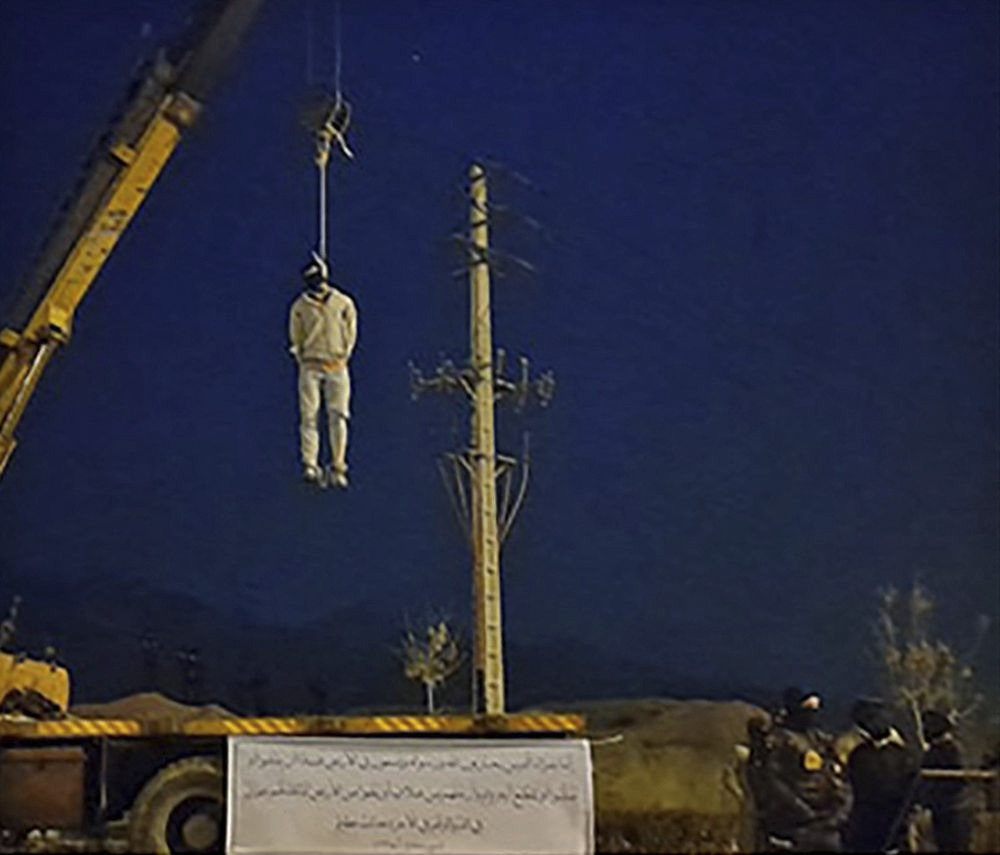
Iran's latest uprising began the way they always do: with humiliation in the marketplace, a collapsing currency, families unable to buy basic necessities, and a generation that has already lived through enough lies to recognize the smell of fear from the regime. What followed was the most serious nationwide challenge to the Islamic Republic since 1979: demonstrations spread across all 31 provinces, cascading through major cities and smaller towns alike, and then the familiar machinery of terror grinding into motion — live fire from police and regime militias, mass arrests, forced confessions, rushed trials, and the deliberate use of executions as a public "lesson."
Estimates of the dead vary: the regime wants darkness. Its week-long internet shutdown turned large parts of the country into a black hole; yet by modern standards, even the low estimates are catastrophic. A senior Iranian official speaking to Reuters put the death toll at around 2,000, while the US-based Human Rights Activists News Agency has reported a toll in the mid-2,500s with more than 18,000 arrests, and Iran Human Rights has published a higher verified figure exceeding 3,000 based on documentation it says it has cross-checked.
Amnesty International has described what amounts to a massacre dynamic, particularly during the peak days of the repression. Bodies arrived faster than families could identify them, and security forces acted with near-total impunity. Names occasionally break through the fog — young protesters sentenced within days, some presumably executed, others disappearing into the prison system — but the movement remains deliberately leaderless, because the regime's first instinct is always decapitation.
The word "revolution" in Iran reflects a population openly testing whether the Islamic Republic can be broken from within and whether the world is prepared to confront a regime that survives only through fear.
As the protests intensified and the death toll climbed, US President Donald J. Trump moved into the frame. His statements were accompanied by a series of visible military signals that were undoubtedly closely watched in Tehran, Jerusalem, and across the Persian Gulf. US strategic bombers were prepositioned to Diego Garcia, the remote Indian Ocean base long associated with contingency planning for Iran. Additional aerial refueling assets were shifted toward Europe to support extended-range operations, while naval deployments in the Gulf region were quietly reinforced. In Kuwait, U.S. facilities increased readiness levels, and regional commanders emphasized force protection measures across CENTCOM's area of responsibility.
Israeli defense authorities placed the country on heightened alert, anticipating that any American strike — however limited — would almost certainly trigger Iranian retaliation on US allies via missiles, drones or proxy forces. In the Middle East, such movements are read as signals, not exercises, and the message was clear: Washington was preparing options. At the same time, Trump's public language reinforced that impression. He warned Tehran that killing civilians would not be tolerated and that if the regime continued firing on its own people, it would face consequences.
For many Iranians, long accustomed to hearing Western leaders express concern while avoiding commitment, the combination of rhetoric and military posture this time felt different. It suggested that at last the United States might be willing to go beyond statements.
The moment of maximum tension came when reports emerged that the regime was preparing a massive wave of executions. Iranian state-linked media and judicial sources spoke of hundreds of death sentences tied to the protests, with numbers circulating that reached as high as 800 planned hangings. It was at this point that Trump publicly escalated his language: "If they start killing people like they have in the past, I think they're going to get hit very hard by the United States."
In another remark, he warned that the United States was watching closely and that Tehran would "pay a heavy price" if the executions went forward. These were not offhand comments; they were delivered deliberately, in front of cameras, and widely broadcast. Then, during a subsequent press conference, Trump announced what he described as a complete reversal by the regime:
"We've been told that the killing in Iran is stopping – it's stopped – it's stopping. And there's no plan for executions, or an execution, or execution – so I've been told that on good authority."
The shift was presented as a result of pressure, and Trump showcased it as proof that deterrence was working. Almost immediately, the sense of impending confrontation receded, and the administration signaled a pause in further escalation.
However, according to the New York Post:
"The ruthless slaughter of anti-government protesters in Iran appears to have stopped — but only because residents are being held hostage in their homes by machine gun-wielding security forces that have flooded the streets, sources told The Post Thursday.... 'There were tanks out — there's tanks everywhere,' the source told The Post after speaking to family in Tehran about the current situation.... 'There are no protests anymore because of massive killings. With 12,000 dead, people are terrified,' the local said..."
The Iranian public absorbed this sequence not as a diplomatic success but as a sudden vacuum. Protesters who had taken to the streets under the belief that the regime was facing unprecedented external pressure now found themselves exposed once again to the familiar reality of unchecked repression. Iranians have learned through bitter experience that when executions are "paused," this does not mean they are canceled: they are "postponed" or carried out quietly, away from international scrutiny. Families of detainees understood that a delay might simply mean time for interrogations, torture, forced confessions, and closed-door trials. In that atmosphere, relief over the suspension of mass hangings coexisted with a far darker concern: that the regime would exact its revenge quietly once the spotlight dimmed.
From a strategic standpoint, the constraints facing the White House were severe. A direct American strike on Iran would have to be a contained punitive action. It could not be allowed to trigger a regional confrontation, drawing in forces across the Middle East, as well as Iranian proxies from Lebanon to Yemen.
Iran possesses a vast missile and drone arsenal precisely intended to impose strategic costs on adversaries, and the regime has repeatedly demonstrated its willingness to strike energy infrastructure, shipping lanes, and civilian targets. Israeli officials made no secret of the fact that their country could face massive missile salvos in the event of a US-Iran clash. Gulf states, while privately hostile to the Islamic Republic, feared becoming the battleground or retaliation target for a war that could devastate oil markets and destabilize their own societies. Meanwhile, the global economy remained sensitive to any potential disruption in energy supplies, and the United States itself is still emerging from years of inflationary pressure.
These realities do not absolve inaction, but they explain why escalation carried risks far beyond Iran's borders. Trump, who has consistently framed himself as opposed to open-ended wars, confronted the same dilemma that has paralyzed Western policy toward Iran for decades: how to punish a regime that thrives on escalation without triggering a conflict whose costs could be measured in thousands of lives across multiple countries.
What this episode ultimately exposed was not simply a tactical decision by one administration, but a structural failure in how the West approaches popular uprisings against entrenched tyrannies. Western leaders are adept at virtue signaling but conspicuously hesitant and fragmentary at follow-through. Expressions of solidarity are issued quickly; commitments to protection are hedged or left deliberately vague.
The Islamic Republic understands this pattern intimately. It knows that it can absorb rhetorical condemnation, wait out media cycles, and then resume repression once attention shifts elsewhere. Tehran's temporary retreat on executions, whether genuine or tactical, fits neatly into this playbook. A regime that has survived more than four decades through systematic violence does not abandon its methods because of warnings. It adapts, recalibrates and seeks to reduce the immediate risk of foreign intervention while preserving its core mechanisms of control.
The danger for the protesters is that external encouragement, when not backed by sustained pressure, can accelerate this cycle by convincing the regime that it must act more efficiently, more quietly, and more ruthlessly.
The question, then, is not whether Trump experienced a moment of hesitation, but whether the West as a whole is prepared to confront the consequences of its own language. Supporting a people in revolt is not cost-free. It implies a willingness to impose sustained penalties on the regime responsible for mass murder and to accept that such penalties might provoke retaliation. Anything less risks creating a cruel asymmetry: oppressed populations are encouraged to rise, while those encouraging them retain the option to disengage. Trump did not invent this asymmetry, but his unusually direct rhetoric made it impossible to ignore. By speaking openly about consequences and then stepping back once Tehran signaled a partial retreat, he exposed the limits of American power in a way that previous administrations often concealed behind bureaucratic language. The result is uncomfortable but clarifying. Either the free world decides that the survival of regimes like Iran's is unacceptable and acts accordingly, or it must stop treating revolts as moral spectacles.
If the Iranian uprising is ultimately crushed, the historical judgment will turn on whether encouragement was matched by tangible help. The Iranian people have demonstrated extraordinary courage in confronting a regime that answers dissent with bullets and nooses.
Iran's regime has revealed, once again, the deadly trap at the heart of Western policy, seen in Ukraine as well as in the Middle East: a willingness to praise bravery without guaranteeing protection. Trump's handling of these crises should be read less as a simple failure or success than as a warning. Words can inspire, but they can also expose countless people to monumental danger. In Iran today, and Ukraine, the difference between success and disaster depends not on declarations, but on whether those who speak the loudest are prepared actually to follow through.
Pierre Rehov, who holds a law degree from Paris-Assas, is a French reporter, novelist and documentary filmmaker. He is the author of six novels, including "Beyond Red Lines", " The Third Testament" and "Red Eden", translated from French. His latest essay on the aftermath of the October 7 massacre " 7 octobre - La riposte " became a bestseller in France.As a filmmaker, he has produced and directed 17 documentaries, many photographed at high risk in Middle Eastern war zones, and focusing on terrorism, media bias, and the persecution of Christians. His latest documentary, "Pogrom(s)" highlights the context of ancient Jew hatred within Muslim civilization as the main force behind the October 7 massacre.
 cammo99