





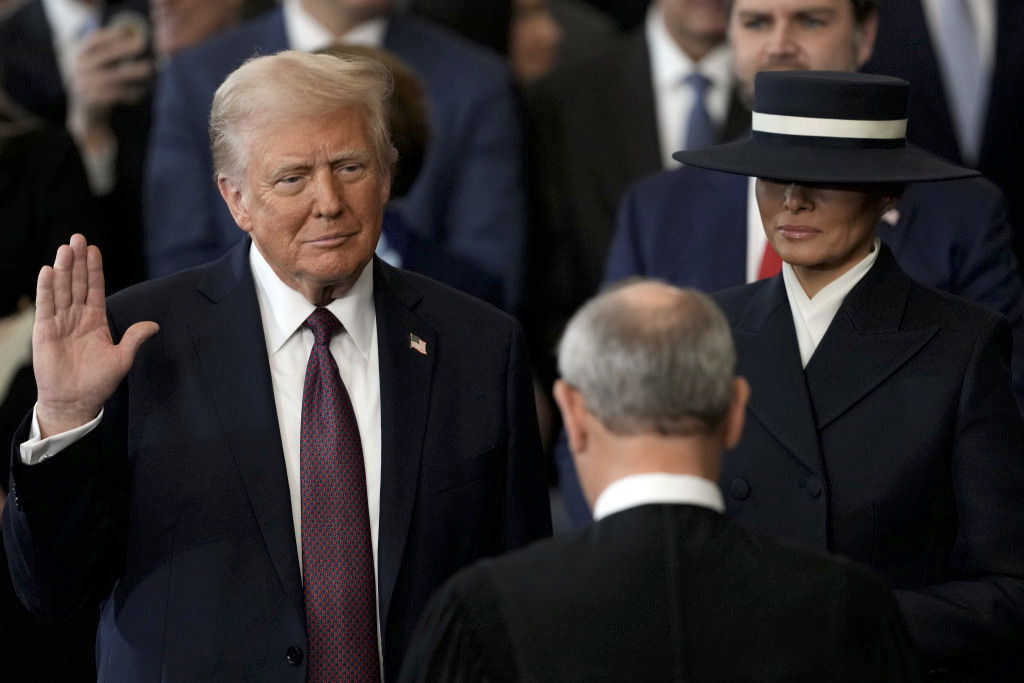
This week marks the first anniversary of Donald J. Trump's return to the White House, and you may or may not want to celebrate.
What you can't do is deny that it has been an exciting year.
The first thing worth noting is that the year in question was different from the first year in Trump's first presidential term, which might be recorded as a case of organized chaos.
In that year, the focus was on how and when Trump would stop his "you're hired, you're fired" show, which had been transferred from TV studios to the White House.
This term, with a minor hitch caused by finding the proper slot for Mike Waltz, the presidential team was quickly mobilized to hit the road from day one. Early speculations about who could be the first to be kicked out faded within days.
More importantly, this time round, all team members understood from day one who is the boss. We had no Rex Tillerson musing about his own foreign policy or John Bolton convinced that he would have been a better president.
The most remarkable feature of the year in question is Trump's success, perhaps unintentionally, in desacralizing power by opening it to the agora with TV cameras that delineate its contours.
We see the president snapping back answers to reporters in a doorway or on his way to board a plane or a limousine. We see him signing treaties, negotiating with foreign leaders, and even quarreling with them on live TV, flanked by a good part of his team acting as chorus.
The low profile imposed on liveries, guards and bureaucrats running hither and thither carrying files and "presidential movements' managers" choreographing the show reminds one of Ulrich, the anti-hero of Robert Musil's 1,700-page novel, when he visited Emperor Franz-Josef's palace in Vienna to find out that if one ignores the paraphernalia of power does one develop more empathy for it.
The next notable feature of the year has been Trump's success, again perhaps unintentionally, to make politics a 24 hour, 7-day business. Whether you are in Timbuktu or Tokyo, Toronto or Tehran, a midnight tweet by Trump could shake you out of your slumber.
The 9-to-5 political day is gone.
Having redefined, not to say annihilated, time and place, Trump has also shaken old cobweb-ridden political institutions. Senators and Congressmen now know that with Trump likely to pull a new rabbit out of a hat at any moment, they can no longer spend much time seat-warming punctuated by occasional apple-pie and motherhood one-liners.
Under Trump, the Republican Party has been reshaped as a hail-the-chief choir, while the Democrat Party is being recast as Chesterton's club of queer trades.
With Trump, we have seen the end, at least for the time being, of the era of grandiloquence in favor of simple, right-to-the-point quips that remind one of Gary Cooper in his Westerns. "We're locked and loaded!" is one example.
Shaking the decadent world order, Trump has also taught everyone that because everything is possible, anything might happen at any time.
He has shaken the United Nations by withdrawing from dozens of "international" agencies acting as gravy trains for the "progressive" elite of tax-exempt bureaucrats and technocrats, all card-carrying members of the Blame-America-First fraternity.
Also shaken out of its slumber has been the North Atlantic Treaty Organization, which had morphed into a lobbying and public relations outfit rather than a military machine to fight putative aggressors. Trump has persuaded NATO members that unless they are ready to at least wash their dishes, the American "room service" might not rush in the dinner trolley.
Trump's in-your-face approach hasn't spared the American military either. He has asked what the use is of spending almost a trillion dollars on a device if it is never used.
A big stick hidden behind one's back is as useless as softly speaking to loudmouth foes. The latest operations against drug traffickers in the Western Hemisphere, most dramatically in Venezuela, may mark a restart moment.
More importantly, perhaps, Trump has led a new round in the cultural war under way in the United States since the end of the Cold War.
In the past three decades, a chunk of the American media and academia has fallen under the control of the modern levelers often known as wokes. They have turned the "humanities" faculties of many universities, supposed to be open to diversity as their name indicates, into caricatures of theological seminaries teaching and preaching one unquestionable truth presented as the cult of victimhood.
Wokeism has introduced an apartheid system in the name of double-barrel identities, and real or imaginary past or present injustices, with the aim of turning the United States into an archipelago of resentments used as bases for revenge by imaginary minorities against an imaginary majority.
The year ends with the US economy strong, unemployment figures down, inflation under control, and reshoring of industries back home under way.
In sum: so far, so good! The application of Bob Wilson's theory of the theater as a "happening" to politics has been refreshing to say the least, with words and deeds pulling the stagecoach together.
Yet, as the first year ends, a word of warning may be in order. Using a wrecking ball to pull down a derelict structure is one thing, but replacing it with something more solid is another. Opening numerous building sites at the same time without sequencing completion may turn out to be as tough as riding several horses at the same time.
Then there is always the possibility of ending up as Dr. Gulliver pinned down by Lilliputians. This is why the good doctor needed the goodwill of at least some of those tiny islanders.
Trump would also do well to remember Shakespeare's line, "Love cools, friendship falls off, brothers divide."
The half-forgotten tiff with Elon Musk was an early warning.
Now we have Vice President J.D. Vance second-guessing his boss on how to deal with the "Iran problem".
Vance may not be recasting himself as the hero of Alfred de Musset's play "Lorenzaccio" to grab power immediately. But with a view to a putative presidential run, he is certainly seeking to curry favor with the MAGA core of Trump's constituency.
The attempt to replace Federal Reserve Chairman Jerome Powell in the final year of his term while he is under criminal investigation may also develop into a bigger showdown with the American ruling establishment still licking its wounds after Trump's return to the White House.
Yet, Trump the quintessential optimist's message remains: The best is yet to come!
We shall see.
Amir Taheri was the executive editor-in-chief of the daily Kayhan in Iran from 1972 to 1979. He has worked at or written for innumerable publications, published eleven books, and has been a columnist for Asharq Al-Awsat since 1987.
Gatestone Institute would like to thank the author for his kind permission to reprint this article in slightly different form from Asharq Al-Awsat. He graciously serves as Chairman of Gatestone Europe.
 Solomon