








In December 2025, Sheikh Saleh bin Abdallah bin Humaid, a prominent imam of the Grand Mosque in Mecca and a member of Saudi Arabia's Council of Senior Scholars, delivered a Friday sermon in which he prayed for God to punish "the Jews" and described Israel as a "cruel Zionist entity."
"Oh Allah, deal with the Jews who have seized and occupied, for they cannot escape your power," bin Humaid said. "Oh Allah, send upon them your punishment and misery, that can never be repelled by the wrongdoers. Oh Allah, we seek your protection from their harms, and we seek refuge with you from their evils."
The imam praised Palestinian children as "among the most joyful examples and noble images are the young children of Palestine."
"Heroic children whose fathers were killed while they watched and whose homes were demolished while they witnessed," he said. "Jerusalem and Palestine will remain high and lofty in the hearts of Arabs and Muslims."
On January 22, in an article published in the Saudi newspaper Al Jazirah, prominent academic Ahmed bin Othman al-Tuwaijri accused the United Arab Emirates (UAE) of throwing itself "into the arms of Zionism" and functioning as "Israel's Trojan horse in the Arab world" in order to weaken Saudi Arabia and emerge as a dominant regional power.
Tuwaijri, a former dean at King Saud University and a former Shura Council member, accused UAE leaders of being "blinded" by "hatred and jealousy" and of turning against Saudi Arabia despite decades of its support. He singled out the emirate of Abu Dhabi for criticism, saying it was pursuing "hostile plots under the guise of diplomacy" and was behind several attempts to destabilize the region, adding:
"In my estimation, what Abu Dhabi is practicing the current state of chaos, destruction, and collusion with the Zionist enemies of the nation against Arab and Islamic countries is a natural consequence of the absence of a truly serious, resolute, decisive, and just Arab system that stands at an equal distance from all."
Tuwaijri claimed that the UAE, which is governed by Mohammed bin Zayed -- a staunch opponent of political Islam -- had collaborated with Israel to the detriment of Arab interests.
"They are trying to shift loyalty from Arab and Islamic solidarity toward external influence," Tuwaijri wrote.
"What a betrayal of God, His Messenger, and the entire nation! What stupidity and shortsightedness! Israel is on its way to rapid demise. And the nation will remain, God willing. This is a betrayal of God, His Messenger, and the entire nation, and it cannot be ignored."
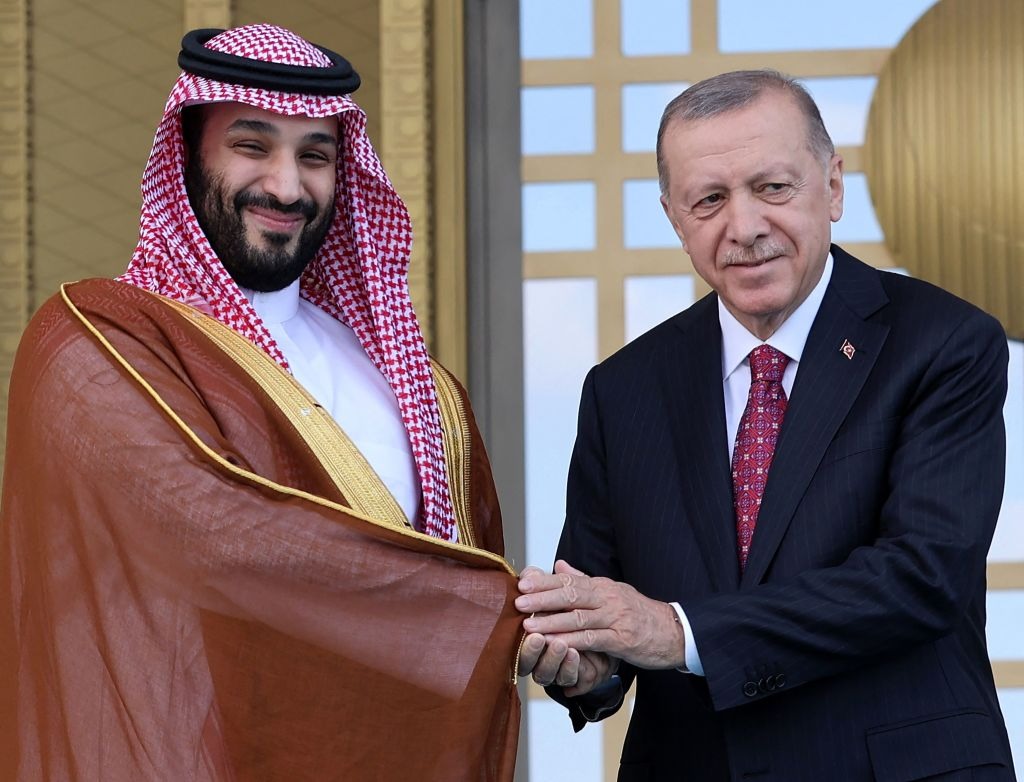
Both Israeli and Arab political analysts recently have pointed out that Saudi Arabia's renewed anti-Israel and antisemitic rhetoric shows that the kingdom is moving away from normalization with Israel in favor of an alliance with the Muslim Brotherhood, Qatar and Turkey, especially now that the US has approved Saudi Arabian Crown Prince Mohammed Bin Salman's request for American tanks and F-35 stealth fighter jets.
Hussain Abdul Hussain, a research fellow at the Foundation for Defense of Democracies, commented:
"Saudi Arabia is undergoing a major regional realignment, abandoning the pursuit of an integrated Middle East with a thriving knowledge economy and dusting off the kingdom's old rhetoric against Zionism and in favor of the Muslim Brotherhood. Last week, Saudi Arabia went as far as lobbying President Donald Trump to spare the Iranian regime, Riyadh's archrival since 1979."
"This followed Saudi Arabia's parting ways with the United Arab Emirates over Yemen. The Saudi air force struck Emirati assets and paved the way for its Yemeni allies—mainly the Muslim Brotherhood's Al-Islah—to expand southward toward Aden. But that was only one piece of the Saudi realignment puzzle."
Hussain noted that some Saudi social media accounts "have now emerged as fully fledged antisemitic." He cited an account with considerable following belonging to Fawaz al-Laboun as asking Arabs and Muslims to choose: "There are two camps. One is Saudi, and the other is Jewish."
Hussain said earlier this month that the Trump administration needs "to have a serious talk with" the Saudis. "I'm ringing the alarm; I'm breaking the glass. I'm saying, listen, these guys are changing."
In the past, "you only got these crazy terrorist clerics, the al-Qaeda types... would be inciting against the Jews," Hussain added. "But this week, the [Saudi] state-owned media was inciting against the Zionist plan to partition the region and to divide the region. This is very new."
According to Israeli journalist Lahav Harkov:
"Anti-Israel and antisemitic messages from Saudi regime mouthpieces and state-sanctioned media have increased in recent weeks, as Riyadh has pivoted away from a more moderate posture to an alignment with Islamist forces, such as Qatar and Turkey...
"An editorial in the Saudi government newspaper Al-Riyadh earlier this month said that 'wherever Israel is present, there is ruin and destruction,' and that Israel 'do[es] not respect the sovereignty of states or the integrity of their territories, while working to exploit crises and conflicts to deepen divisions.'"
Edy Cohen, a research fellow at the Israel Center for Grand Strategy, told Jewish Insider that the Saudi-backed Arabic news channel Al Arabiya is "very anti-Israel, they glorify the Palestinians."
One reason for the turn in Saudi messaging is that Riyadh is "very afraid of Israel," Cohen said, noting that it views recent Israeli actions as going against Saudi interests.
Cohen noted that Saudi Arabia was mostly quiet about Tehran's violent suppression of the recent nationwide demonstrations, but behind the scenes, "the Saudis and the Qataris led a campaign for Trump not to strike Iran."
"[The Saudi leadership] heard [exiled Iranian Crown Prince Reza Pahlavi] said the new Iran will normalize relations with Israel, and this drove the [Saudi and Qatari] leadership crazy. Imagine Iran and Israel together ... the Shi'a and the Jews together; it's their biggest nightmare."
According to Harkov:
"Abdul-Hussain put Saudi's pivot in the context of its failed regional ambitions. Saudi Arabian Crown Prince Mohammed bin Salman, known as MBS, sought to move 'from a country that has relied on oil for a living ... to a country that looked like Dubai, where you have tourism and services, what they call a knowledge economy. ... Israel is clearly one of the highest knowledge economies in the world.'
"However, Abdul-Hussain said, 'his experiment has just hit a wall and this transformation is not happening'... Now, Abdul-Hussain said, 'the quickest tool that [MBS] can get is to reconnect with the Islamists. ... Look at Turkey and Qatar using Islamism all the time to project influence, including in Gaza ... Washington clearly likes them for some reason, so [MBS is] thinking, why not use Islamism ... as a tool to project power at Saudi's borders? This means they will have to bash the heck out of Israel.'"
Prominent Israeli journalist Amit Segal also weighed in on the shift in Saudi Arabia's position:
"Here is the updated assessment now being heard in important capitals in the region: normalization with Saudi Arabia is dead, at least for the foreseeable future. The strategic decision to pursue reconciliation with Israel has been replaced by a wild incitement campaign, whose depth and damage are questionable in terms of awareness. When Qatar's 'plastic empire' attacks Israel via Al Jazeera, it is very harmful—but when the preacher in Mecca poisons the entire Sunni world against Israelis, that is something else entirely.
"Over the past month, [Saudi-owned] Al Arabiya has been worse than Al Jazeera in the texts broadcast against any normalization with Israel. Saudi podcasters who specialize in luxury cars or sports are suddenly cursing Zionism and the Abraham Accords. The broader context is the Saudi-Emirati military confrontation in Yemen—an attack that should greatly worry Israel and the United States, and that delights the Houthis, who watch their enemies fight one another.
"Why is this happening? Strangely, Israel has fallen victim to its historic success in severely damaging Iran's nuclear project and its proxy network. In 2015, the Saudi king sent Netanyahu a note congratulating him on his speech to Congress against the nuclear deal. That is where the seeds of cooperation with the moderate Sunni states were sown, culminating in the Abraham Accords. When concern over Iran reached its peak and interest in the Palestinian issue reached a low point, the de facto ruler, Mohammed bin Salman, embarked on a campaign to prepare hearts for peace with Israel. The date was late September 2023.
"[The Hamas-led] October 7 [invasion of Israel] changed everything: it both reignited Arab interest in the Palestinian issue and led to an Israel–Iran war on seven fronts. Saudi Arabia received, for free, the goods it wanted in Tehran, and the price it demanded on the Palestinian issue rose sharply. Contrary to the impression created, Netanyahu and [former Israeli minister and prime minister advisor Ron] Dermer were not particularly eager to pay any price to the Saudis either. 'If not, then not—no force,' Netanyahu said in one cabinet meeting.
"Now, with the Saudis no longer celebrating the Abraham Accords, they are trying to undermine their foundations of support, from Morocco to the Emirates. Someone I spoke with this week used an Arab proverb to explain it: "He who cannot reach the grapes says they are sour." I suggested an Israeli version, straight from air-defense battle lore: 'If I don't fly, nobody flies.'
"Donald Trump has a move or two available in Riyadh. Israel and its friends in the region should ask him to use his influence to halt the toxic campaign against his main international legacy and make clear that an attack on the accords is an attack on him."
Saudi Arabia's latest anti-Israel campaign raises serious questions about the kingdom's purported desire to join the Abraham Accords in the first place, as well as the long-term reliability of other professed allies: in particular Qatar, Turkey, Russia and Pakistan.
Over the past few years, Mohammed bin Salman found excuses to procrastinate, often by conditioning normalization with Israel on the establishment of a Palestinian terror state next to Israel. In the aftermath of the October 7 massacre, it is obvious that such a state would pose an existential threat to Israel, as would the presence of Qatar, Turkey, Hamas, Russia and Pakistan planted on the Gaza Strip when Trump will no longer be in office to guard it.
Perhaps this is the right time for Trump to reconsider his ties with bin Salman -- and other putative "friends" -- and cancel the recent contract to sell the Saudis that fleet of F-35 stealth fighter jets.
Bassam Tawil is a Muslim Arab based in the Middle East. His work is made possible through the generous donation of a couple who wish to remain anonymous. Gatestone is most grateful.
 Leon Mintz