








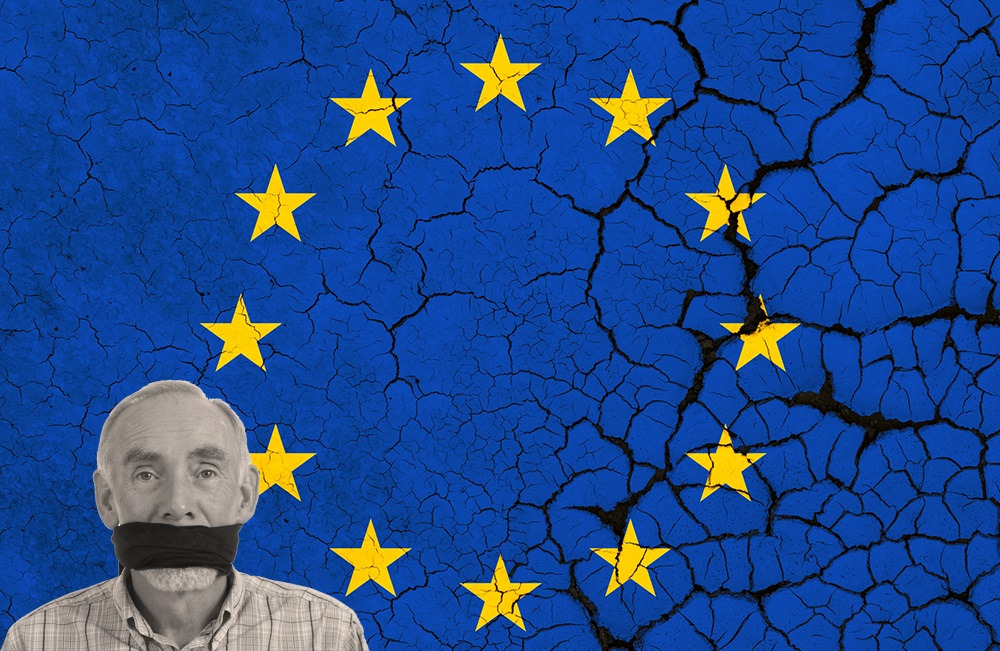
Governing elites in Europe, in what increasingly appears to be the EUSSR (European Union of Soviet Socialist Republics) race to the bottom, have been growing ever more unpopular. Disapproval ratings are skyrocketing. In France, 77% of the public disapprove of President Emmanuel Macron. In Britain, 68% disapprove of Prime Minister Keir Starmer. In Germany, 64% disapprove of Chancellor Friedrich Merz, and in Spain, 61% have had it up to here with Prime Minister Pedro Sanchez.
In other parts of Europe, such as Germany and France, all sorts of pseudo-legal acrobatics are being generated to prevent political opponents from running for high office (such as here and here).
So, if you are an unpopular regime desperately clinging to power, what do you do? It's easy! Iran's ayatollahs, China's Xi Jinping, Russia's Vladimir Lenin, Josef Stalin and Vladimir Putin could tell you. You simply crack down -- more than ever -- on free speech and dissent!
In supposed democracies, this latest "benefit " to your people - cracking down on dissent "democratically" -- means using technology rather than firepower to crush freedom of speech.
Concerning age limits for children, there is a valid argument to be made that leaving the faces of a generation staring at screens all day appears to be impairing not only their education but also their ability to socialize with anyone not an AI chimera, algorithmed to agree narcotically with everything uploaded, including the best ways to how to put their young, ostensibly deficient lives to an end.
As the founder and CEO of Telegram, Pavel Durov wrote on X:
Today, Telegram notified all its users in Spain with this alert:
Pedro Sánchez's government is pushing dangerous new regulations that threaten your internet freedoms. Announced just yesterday, these measures could turn Spain into a surveillance state under the guise of "protection." Here's why they're a red flag for free speech and privacy:
1. Ban on social media for under-16s with mandatory age verification: This isn't just about kids—it requires platforms to use strict checks, like needing IDs or biometrics....
⚠️Danger: This will force over-censorship—platforms will delete anything remotely controversial to avoid risks, silencing political dissent, journalism, and everyday opinions. Your voice could be next if it challenges the status quo....
⚠️Danger: Governments will dictate what you see, burying opposing views and creating echo chambers controlled by the state. Free exploration of ideas? Gone—replaced by curated propaganda....
⚠️Danger: Vague definitions of "hate" could label criticism of the government as divisive, leading to shutdowns or fines. This can be a tool for suppressing opposition. These aren't safeguards; they're steps toward total control. We've seen this playbook before—governments weaponizing "safety" to censor critics....
Demand transparency and fight for your rights. Share this widely—before it's too late.
Durov, incidentally, born in the Soviet Union in 1984 – of all Orwellian dates! – left Russia in 2014 after Russia's FSB security service demanded that his company, VKontakte, hand over the personal data of Ukrainian Euromaidan protesters and opposition figures, and for refusing to censor posts on his site.
In Spain, in addition to an arguably justified ban on social media for people under 16 years old, Sanchez's government is introducing a legislative package consisting of five additions to censor speech online.
First, social media platform executives will not just be fined for failing to remove "illegal, hateful or harmful" content from their platforms in a timely way – they will also now face criminal liability, including possible imprisonment. As Durov warns:
"This will force over-censorship—platforms will delete anything remotely controversial to avoid risks, silencing political dissent, journalism, and everyday opinions. Your voice could be next if it challenges the status quo."
"Sanchez," Elon Musk said more bluntly, "is the true fascist totalitarian."
Second, amplifying "illegal" or "harmful" content through the algorithms will become a crime.
"We will turn algorithmic manipulation and amplification of illegal content into a new criminal offense," Sanchez said. "No more hiding behind code. No more pretending technology is neutral."
Third, according to Sanchez:
"We will implement a hate and polarization footprint system to track, quantify, and expose how digital platforms fuel division and amplify hate. For too long, hate has been treated as invisible and untraceable, but we will change that."
The problem, of course, is that usually "hate" is never defined -- meaning that anything and everything can be labeled "hate" and often is. Judgments about what constitutes "hate" become entirely subjective and run the danger of existing exclusively "in the eye of the beholder."
In Sudan, for instance, a British teacher at an elementary school was sentenced to 40 lashes and a term in prison for having allowed her students to name a teddy bear Muhammad. In Iran today, people who protested against the regime are being sentenced to death for "waging war against God."
The United States officially enshrines freedom of speech in the First Amendment to the Constitution:
"Congress shall make no law respecting an establishment of religion, or prohibiting the free exercise thereof; or abridging the freedom of speech, or of the press; or the right of the people peaceably to assemble, and to petition the Government for a redress of grievances."
US courts have ruled that only child pornography and immediate, direct and credible threats, as well as a few other limitations, are banned.
Some governing elites in Spain apparently want to ban X there altogether. "The next battle should be aimed at limiting... and likely banning Twitter," Minister of Youth and Children Sira Rego stated.
Spain's Deputy Prime Minister Yolanda Díaz, announced that she has left X and that whoever remains on X "is feeding hate policies."
France is planning a similar move, "to ban minors from Instagram and TikTok," and Germany is also seriously considering introducing such a ban as well. Germany's Christian Democratic Union — the conservative party led by Chancellor Friedrich Merz and the largest in the governing coalition — is reportedly set to discuss the issue at its national party congress on February 20-21, 2026.
Denmark, Greece and Britain are also in various stages of either introducing or seriously considering banning X, and European authorities are simultaneously seeking to come up with other ways to close down X.
At the beginning of February, French authorities and European Union police agency Europol raided X's offices in Paris, over "suspected abuse of algorithms, plus allegations related to deepfake images and wider concerns over posts generated by the platform's AI chatbot, Grok," according to Time Magazine.
According to The Telegraph, the raid "was triggered in the first place by an MP in Emmanuel Macron's centrist party complaining, after Musk's purchase, that X had 'reduced diversity of voices', and a separate complaint that the site hosted 'nauseating political content'".
In Britain, according to The Telegraph:
"[T]he Information Commissioner's Office launched an investigation into deepfakes on X, running in parallel to the Ofcom inquiry into the platform. Liz Kendall, the Technology Secretary, has said the Government will give its 'full backing' should the watchdog decide to block access to the site in the UK and accused those opposing the measures of allying with 'those who think the creation and publication of sexually manipulated images of women and children is acceptable'."
All this is in addition to a €120 million fine that the European Commission has imposed on X under its "Delete. Silence. Abolish" Digital Services Act.
To the European governments that refuse to acknowledge that many of their citizens are sick and tired of their repressive policies, when the ayatollahs slaughter their citizens in Iran, it is not a pressing problem, but banning X is of the highest priority.
Robert Williams is based in the United States.
 Mehul Kamdar