








As international attention is focused on the Iran war, the Palestinian Hamas terror group has stepped up its crackdown on the Palestinian people as part of its effort to reassert its control aggressively over the Gaza Strip.
Hamas's measures are in violation of US President Donald J. Trump's plan for ending the Israel-Hamas war, which erupted on October 7, 2023 when the Iran-backed terror group invaded Israel and murdered more than 1,200 Israelis and foreign nationals.
According to the Trump peace plan, announced late last year:
"Hamas and other factions agree to not have any role in the governance of Gaza, directly, indirectly, or in any form. All military, terror, and offensive infrastructure, including tunnels and weapon production facilities, will be destroyed and not rebuilt. There will be a process of demilitarization of Gaza under the supervision of independent monitors, which will include placing weapons permanently beyond use through an agreed process of decommissioning..."
The Trump administration and its newly established "Board of Peace," however, have failed to call out Hamas for its ongoing breach of the terms of the ceasefire plan. Hamas has evidently interpreted this silence as a green light to pursue its effort to rearm, regroup and rebuild its regime by killing, torturing, and economically squeezing the residents of the Gaza Strip.
Hamas's crimes against Palestinians do not surprise anyone. This is the governing model it has used since violently seizing the Gaza Strip from the Palestinian Authority in 2007.
Ranjan Solomon wrote this month in Middle East Monitor:
"Hamas governs from within a shattered enclave of two million people. The Board of Peace governs from a conference table in Washington.
"Hamas collects shekels in taxes on smuggled goods; the Board has no independent revenue stream.
"Hamas integrates 10,000 police personnel into proposed structures; the Board must still wait for countries to commit personnel to a stabilization force.
"Hamas appoints governors and mayors; the Board awaits reports."
Hamas is rebuilding its financial machinery by collecting taxes, fees, and customs charges on goods entering the Gaza Strip. The money is not being invested in reconstruction. Instead, it is going toward rebuilding the terrorist group's military capabilities.
Last month, Reuters quoted an Israeli military assessment that warned that Hamas is cementing its hold over the Gaza Strip by placing loyalists in key government roles, collecting taxes, and paying salaries to its operatives. According to the report:
"Israeli military officials say Hamas, which refuses to disarm, has been taking advantage of an October [2025] ceasefire to reassert control in areas vacated by Israeli troops....
"Hamas has named five district governors, all of them with links to its armed al-Qassam Brigades, according to two Palestinian sources with direct knowledge of its operations. It has also replaced senior officials in Gaza's economy and interior ministries, which manage taxation and security, the sources said."
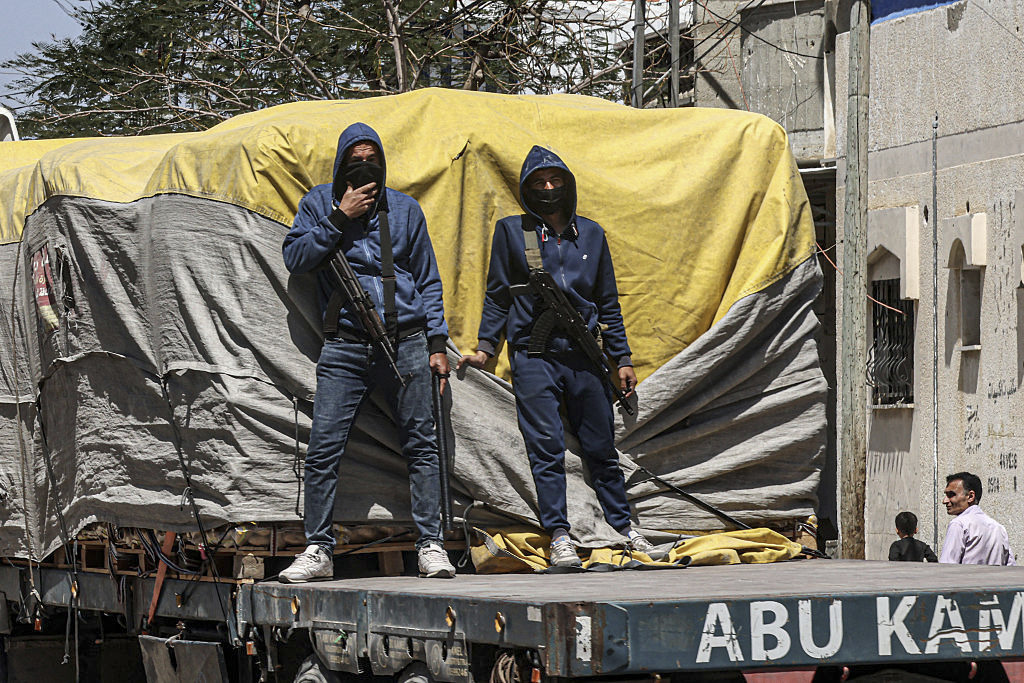
Last week, Hamas police officers reappeared on the streets of the Gaza Strip with their vehicles, in yet another sign that the terror group has returned to ruling the territory.
Hamas, in addition, has murdered, arrested, assaulted, or summoned for interrogation dozens of Palestinians for allegedly speaking out against the terror group.
A recent video circulating on social media shows Hamas terrorists shooting an unidentified man in the town of Deir al-Balah in the Gaza Strip, then preventing him from receiving medical treatment.
Gaza-born political activist Hamza Howidy wrote last week:
"Since the war with Iran began, Hamas's thugs have intensified their brutal, savage, barbaric campaign against Gaza's own residents. The people in this photo are just some of many who have been executed, shot, kidnapped, or brutally tortured in recent weeks. The list of atrocities grows by the day, and the sheer sadism on display goes beyond anything comprehensible (even for those of us who were born and raised in Gaza and saw Hamas's brutality up close for years). We thought we had seen the floor of their depravity. There is no floor for those people.
"I have shared many of these stories, and in many cases they were later confirmed by journalists and activists inside Gaza or diaspora Gazans. The 'crime' those people committed? Saying their own opinions.
"What makes this even worse than the suffering of those victims itself is the silence of the people who built entire careers screaming about Palestinian suffering. The same commentators, the same "human rights advocates," the same influencers, and the same media outlets that spent months positioning themselves as the moral conscience of the world, packaging Palestinian pain into clout, followers, and book deals, have gone completely dark....
"The Palestinians left to die under Hamas's boots are apparently the wrong kind of Palestinians, too inconvenient, too disruptive to the narrative, and too alive in ways that don't serve 'the cause'".
Commenting on the reappearance of Hamas police officers, another Gaza-born political activist, Ahmed Fouad Alkhatib, wrote on March 12:
"Hamas terrorists conducted a parade in their trucks inside the al-Mawasi tent zone for the displaced. These gunmen are the same ones who are killing, kidnapping, torturing, and shooting Gazans every single day; they're making their presence known to say "shut up & pay us taxes"! They hide in tent areas and use civilians as shields to lessen the chance of being struck by Israeli drones and air strikes. Just ask yourself: why would a terror organization do a parade of its militiamen in the middle of a tent city, if it weren't either hiding among the tents, or seeking to terrorize its inhabitants?"
Alkhatib revealed last week that Hamas members recently tortured a friend of his who dared to criticize the terror group:
"Hamas's fascist militias tortured my dear friend Ashraf Naser Shallah, who has been in and out of hospitals in Gaza City over the past couple of days. They took his phone, stole his wallet with critical documents, and threatened to kill him if he continued to speak out against their terrorism, the Iranian regime, the fraudulent 'resistance' narrative, the desire for peace with Israelis, and his refusal to be cannon fodder in failed Jihadi ideologies that have destroyed the Palestinian people in Gaza."
On March 10, Hamas terrorists shot and killed Asa'ad Abu Mahadi for unknown reasons. His nephew, Waseem Abu Mahadi, wrote on March 10:
"My uncle, 'Abu Younis,' died today in the hospital.
"On Sunday, a Hamas terrorist militia checkpoint opened fire on his civilian car while he was driving with his son. He was critically wounded. For two days he fought for his life in the hospital. Today, he died.
"My uncle was not involved in politics or any faction. He was a peaceful man who loved his family and tried to live a normal life.
"After the shooting, we were told that he had been shot BY MISTAKE.
"A mistake...
"As if shooting at a civilian's car is just an unfortunate accident. As if another Palestinian life disappearing into the chaos of militias and guns can simply be brushed aside.
"This is what happens when the rule of law disappears and terrorist militias take its place."
In another incident, Hamas members assaulted Mohammed Abu Amra inside al-Aqsa Hospital in Deir al-Balah, where he was tied to the bed despite his injury, and the medical teams were prevented from completing his treatment.
As long as the world's attention remains focused elsewhere, Hamas will continue to rebuild its authority in the Gaza Strip without facing serious international scrutiny. Hamas seems to believe that time works in its favor. The longer the international community's silence persists, the easier it becomes for the terror group to reestablish itself as the only legitimate power.
While some international parties continue searching for diplomatic formulas and peace plans to stabilize the Gaza Strip, Hamas has made one thing abundantly clear: it has no intention of relinquishing terrorism or power. Until that reality changes, no peace plan will have a realistic chance of transforming the future of the Gaza Strip.
Khaled Abu Toameh is an award-winning journalist based in Jerusalem.
 Neal
Neal