








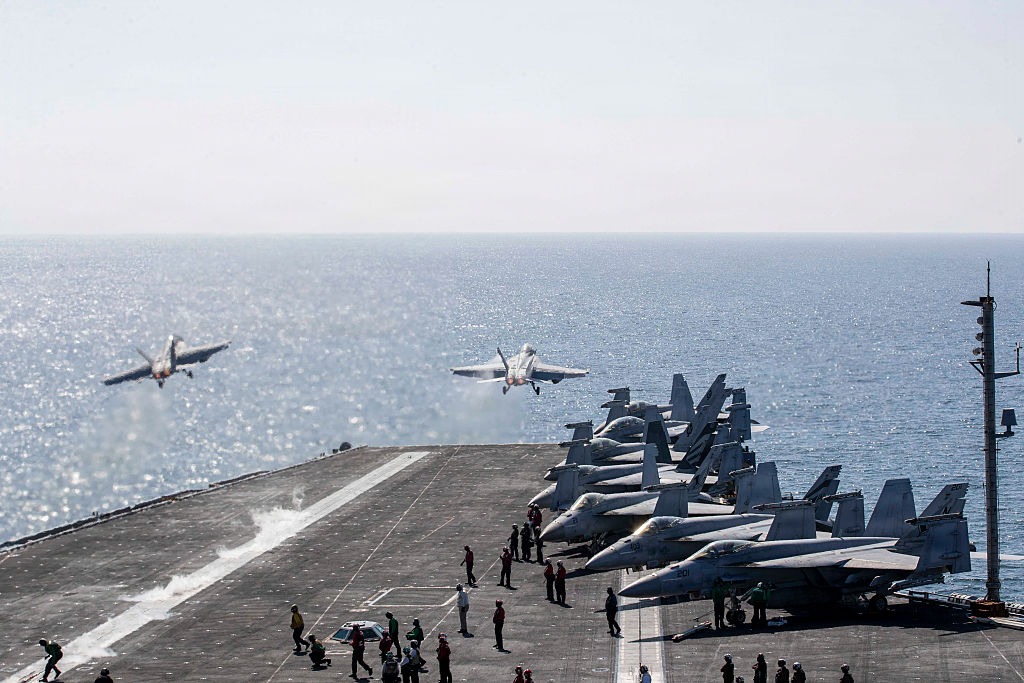
With the war between the Israel-US duo and the Islamic Republic in Iran entering its third week, two questions are asked in policy circles across the world.
The first is: how long will it last?
The answer is: how long is a string?
Which means: because no one knows, no speculation is warranted.
The second question may be beyond a journalist's bailiwick.
As one of my mentors in journalism taught so many decades ago, we had better leave history to historians and guessing the future to futurologists.
However, using a dose of sophistry, one might claim that op-eds represent a hybrid form of journalism that allows a measure of exemption from the mentor's rule through pontification. With that admittedly lame excuse, one could imagine five scenarios in which this war might terminate.
The first is for President Donald Trump to do what he has done many times: declare victory and move to something else.
When the US started firing Tomahawk missiles at Iran last month, many hoped it would be a quick, surgical operation, similar to last June's strike against Iran's nuclear facilities, allowing Trump to offer footage showing such sites as Natanz, Isfahan and Heron Mountain turned into a pile of rubble.
However, we are now told by many, including the IAEA's Director Rafael Grossi, that Iran has many unidentified sites spread all over the country. Moreover, no one knows where Tehran is hiding its 400 kilograms of enriched uranium that could be upgraded to build nuclear warheads within a short time.
In that scenario, Trump wouldn't be able to declare victory without Grossi giving Iran a clean bill of health. And that would put Trump in the same spot that four of his predecessors were when Hans Blix, Mohamed ElBaradei and Yukio Amano ran the IAEA and refused to say whether or not Iraq, and later Iran, were building the bomb.
Thus the first scenario appears too dicey.
The second scenario is for Trump to refocus on Iran's arsenal of missiles by claiming it has been wiped out, thus enabling him to end the war. However, that would mean becoming hostage to fortune. It would be sufficient for Tehran to fire a ballistic missile or launch an attack drone just days after Trump's declaration of victory to show that the leader of the mightiest power in history has thrown in the towel a bit too soon.
The third scenario, favored by some in Trump's kitchen cabinet but absolutely hated by Israeli Prime Minister Benjamin Netanyahu, is the Venezuela model: having decapitated the regime, you allow it to squeal and survive under a second tier of leaders.
That scenario may not be applicable to Iran for two reasons.
First, the Venezuela of Hugo Chavez and Nicolas Maduro did not want to wipe Israel off the map and drive the Yankees out of Latin America. Nor did Venezuela have proxies in the American backyard and sleeping terror cells inside the US.
Chavez and Maduro were Che Guevara T-shirt revolutionaries who used leftist gibberish but were more interested in filling their pockets. The Islamic Republic of Iran, however, is built around anti-Americanism and antisemitism. As Iran's former Foreign Minister Muhammad-Javad Zarif says: If we do not stand against America, no one would pay any attention to us. Even if we have the nuclear bomb, we would be something like Pakistan!
A second or third tier of Khomeinist leadership in Tehran might have to be even more radical to keep what is left of the regime's base.
We caught a glimpse of that last week when regime propaganda cited four conditions supposedly set by the still invisible "Supreme Guide" Mojtaba Khamenei, to halt attacks on Iran's neighbors.
The first is the closure of all American bases in the Middle East.
The second is for all OPEC members to terminate economic and commercial ties with the US and expel American businesses.
The third condition is for all Arab countries to withdraw their investments from the United States. Finally, oil prices from the region should no longer be quoted in dollars but in a basket of BRICS currencies.
More intriguing is the demand by the ayatollah or the ventriloquist behind him for the US to pay compensation for damage done to Iran's infrastructure.
A putative Iranian Delcy Rodriguez wears pants, sports a bushy beard and sleeps with a Kalashnikov by his side.
The second reason why the Venezuela option, if one could call it that, might not work in Iran is that Israel is killing Rodriguez wannabes, the latest being Ali Larijani, alias Ardeshir.
Iran's so-called New York Boys might have done a Rodriguez number before the war but now are in danger of being done for by more radical fellow-Khomeinists.
The fourth scenario is to just continue bombing and see what happens. However, there, too, problems might arise.
After a week or two, the US and Israel may run out of military or dual-use targets to hit.
That would oblige the artificial intelligence algorithm, which we are told fixes the targets, to recommend hitting just anywhere and anything. That could create millions of displaced persons who would not be pleased with the US and Israel.
That, in turn, might turn Iran, one of the few nations where the US and even Israel enjoyed a good image, partly because of historic reasons and partly as a result of opposition to the Khomeinist regime, into another market for anti-American and antisemitic discourse we see in Western Europe.
That scenario entails another risk that one could label the Sonny Liston conundrum.
In his memorable fight with Muhammad Ali (Cassius Clay), Liston, reputed to be the strongest prize fighter in history, pushed his adversary to the ropes and kept hitting him with all his force.
Clay took the blows and waited until Sonny was exhausted and ready for a knockout by a weaker adversary.
In the case of the current war, that exhaustion may not take a physical form but could come in political, economic and morale forms.
The fifth scenario, though based on a fantasy inspired by a puff at a non-existent calumet, merits being mentioned.
Trump will hold his rescheduled summit with Chinese President Xi Jinping in Beijing in April.
Would that not be a good occasion to declare victory and end the war in exchange for Xi guaranteeing to keep the moribund Khomeinist regime on a tight leash until Iranians themselves find a way out of the deadly maze created by the ayatollahs almost half a century ago?
Amir Taheri was the executive editor-in-chief of the daily Kayhan in Iran from 1972 to 1979. He has worked at or written for innumerable publications, published eleven books, and has been a columnist for Asharq Al-Awsat since 1987. He graciously serves as Chairman of Gatestone Europe.
Gatestone Institute would like to thank the author for his kind permission to reprint this article from Asharq Al-Awsat.