








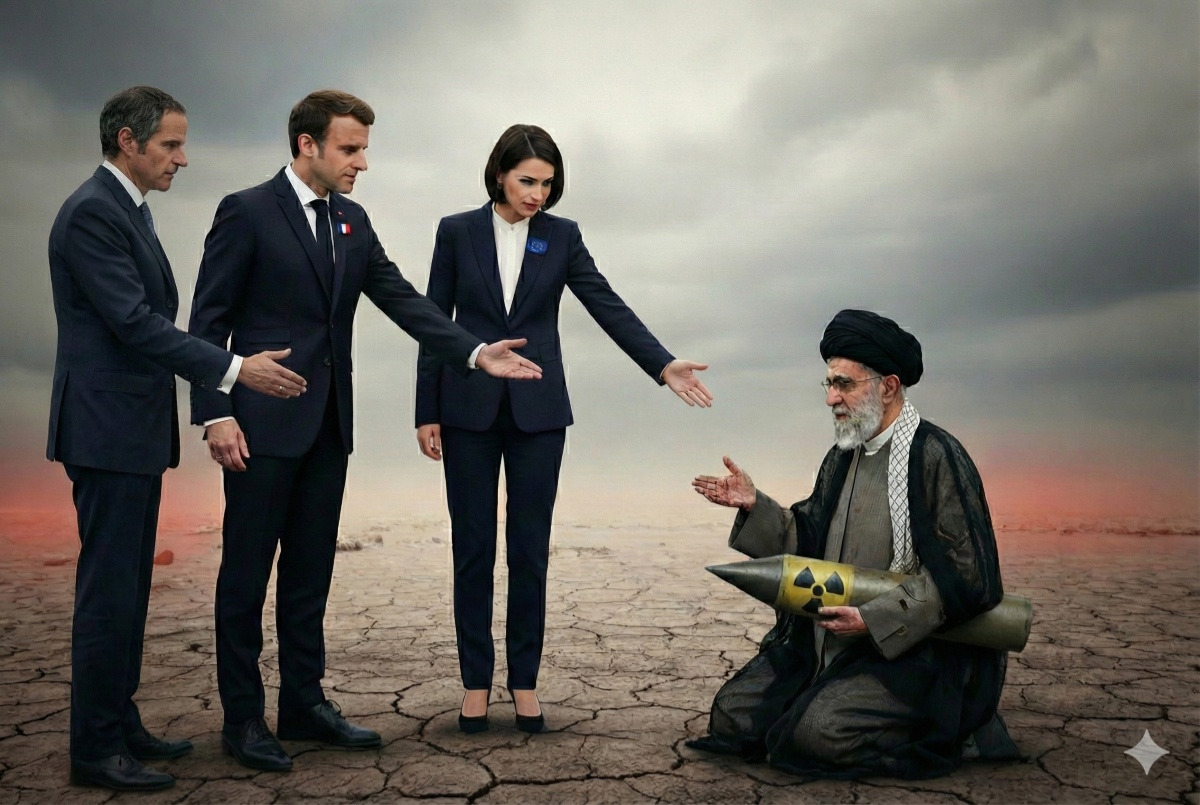
The European Union is reportedly preparing to sit down with Iran to negotiate on its nuclear program -- again. Even Rafael Grossi, head of the International Atomic Energy Agency (IAEA) -- the UN's nuclear watchdog -- seems interested in engaging Iran in "diplomacy" again.
Iran's regime, not surprisingly, appears more than happy to accept these overtures. On the surface, this international charm offensive may appear to be a constructive effort toward dialogue, but a dryer analysis suggests that such negotiations risk handing a monumental victory to a vicious regime that is vulnerable and weak -- and rabidly opportunistic. By offering Iran another platform for legitimacy, the EU and the UN are shoring up a monumentally brutal regime at a time when, for the West's own good, it should be applying pressure, not extending a hand.
Iran's nuclear program was, after half a century of international procrastination, finally damaged in a significant way by strikes carried out by Israel and the United States. The damage has left the regime not much to offer in return for concessions, although the only concession called for is to stop building nuclear weapons and ballistic missiles. In a normal negotiation, a party with strong assets might offer something other than what the other party wants, in exchange for sanctions relief, but this is not Iran's situation at the time.
Paradoxically, its vulnerability is precisely why Tehran is in a position to gain from any talks: it can accept almost any terms, secure relief from sanctions, and breathe new life into its struggling economy, its ballistic missile program and its nuclear weapons program, all without giving up anything of real value. That is why engaging in talks now is strategically flawed: it would literally reward bellicosity and hand the regime an opportunity to re-consolidate its power.
Engaging with Iran in formal negotiations setting also confers legitimacy on a regime whose human rights record is deeply troubling, if not abysmal. Over the past year, both the regime's executions -- more than 1,000 just in 2025 -- and its repressive measures have raised alarms across the globe, yet EU and UN officials nevertheless appear eager to sit down with the very leaders responsible for those atrocities. Every handshake and photo opportunity signals normalizing the regime's actions and, by extension, disempowering the moral authority of the international community. The West would be empowering hardline factions, boosting the morale of Iran's military and paramilitary forces, and sending a message that ruthless repression is acceptable -- so long as Iran will sit down to talk and buy itself more time.
The 2015 Joint Comprehensive Plan of Action ("nuclear deal"), negotiated under the Obama administration and European powers, was intended to curb Iran's nuclear ambitions in exchange for sanctions relief. On paper, it was a diplomatic triumph; in practice, the economic and political empowerment resulting from the deal allowed Iran to expand its influence across the Middle East, and support terrorist groups and militias that destabilized the region, culminating with the Hamas invasion of Israel on October 7, 2023.
Rewarding the Iranian regime with international legitimacy and economic relief reinforces its aggression; it does not restrain it. Western powers, therefore, should focus not on negotiations, which validate the Iranian regime, but on applying sustained pressure where it is most effective – in particular targeting Iran's oil sector and the financial networks that sustain the regime. These measures would limit Iran's ability to fund its nuclear program, ballistic missile production, and network of proxy terrorist groups and militias. At the same time, there should be a push for a total, extremely verifiable, dismantlement of its nuclear and missile programs, and full cooperation with international inspectors.
Anything short of complete transparency and disarmament simply repeats past mistakes, where concessions were not meaningful guarantees, to say the least, and in fact provided a pathway for Iran to continue developing nuclear weapons.
There is an imperative to consider the voices of the Iranian people, who have risked their lives, again and again, for justice and freedom. Tens of thousands of Iranian citizens have taken to the streets to oppose the Iranian regime over the years despite severe consequences, yet negotiations with Tehran often occur without the slightest interest in their plight. By granting legitimacy to a regime that represses its own citizens, the EU and UN disgrace themselves as well as betraying those Iranians fighting for basic human rights.
The efforts by the EU and the IAEA to resume talks with Iran are misguided and, frankly, dangerous. Iran's regime apparently does not see a need for reforming or have the slightest intention of doing so.
Dr. Majid Rafizadeh, is a political scientist, Harvard-educated analyst, and board member of Harvard International Review. He has authored several books on the US foreign policy. He can be reached at dr.rafizadeh@post.harvard.edu
 Ralph
Ralph