








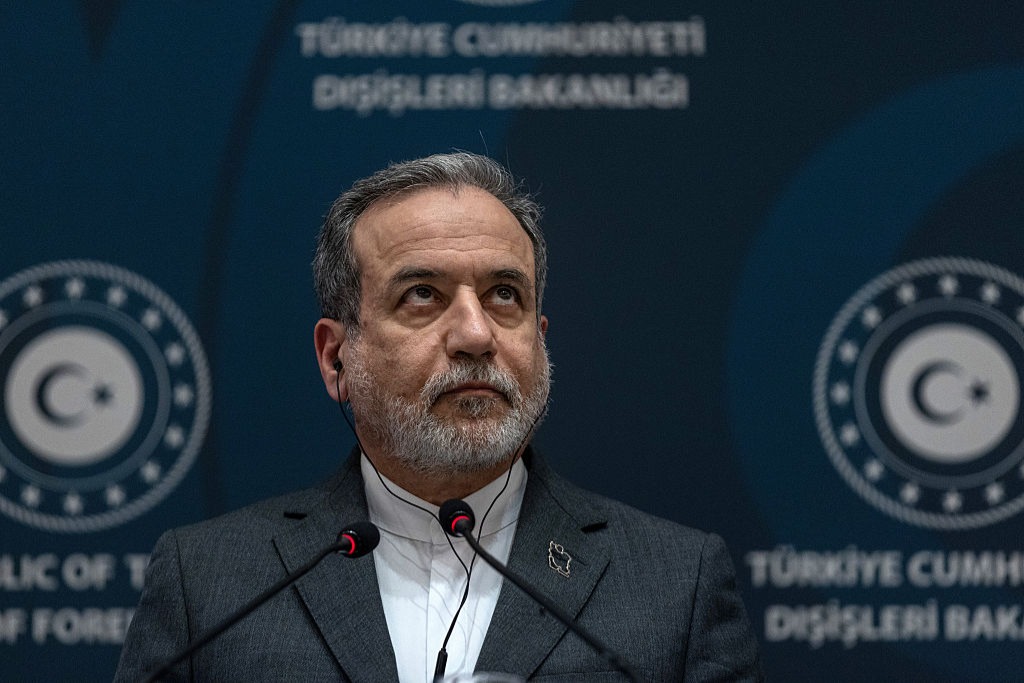
Iran's rulers, now that they are on their knees, apparently want to "talk." Iranian officials, including the foreign minister, have signaled openness to negotiating a new nuclear deal -- not from "moderation" or a genuine change in behavior. The plea from Iran's regime is clearly a last-ditch effort to hold on to power so the mullahs can keep on torturing, slaughtering and putting out the eyes of their citizens.
The regime is searching for a way out. This moment, therefore, is not one for misplaced diplomatic optimism that the mullahs are now prepared to stop building nuclear weapons and ballistic missiles that can reach the United States, or to stop brutalizing innocent Iranians. The regime, which rules by terror, is evidently still hoping to rule the rest of the world by terror, too.
This pattern is, in fact, how the Islamic Republic of Iran has operated since its founding in 1979. Whenever the regime feels strong — flush with cash, regionally influential, diplomatically legitimized — it is defiant, aggressive, and expansionist. Whenever Iran's regime feels weak, it discovers "negotiations." In Shia Islam, you are told that if "Islam" is being threatened, you are to practice dissimulation (taqiyya). For Iran's mullahs, "talks" have always been a tactic to buy time, reduce pressure, and strengthen their hand.
After years of sanctions and mounting pressure during the latter part of the Bush administration, after its participation in the 9/11/2001 attacks on the US, the Iranian regime found itself economically strained and politically cornered. When President Barack Obama came to power, Tehran quickly pivoted toward negotiations. The result was a fake deal that rescued the mullahs when they were at their most vulnerable. The deal offered not only "breathing room," but more than $150 billion, and, after a few years – which would already have ended on October 18, 2025 – as many nuclear weapons legitimately as the regime could have built. This "breathing room" not only led to the Iranian regime's re-empowerment, but helped to finance its entire war industry, including the nuclear weapons.
In 2015, flush with cash and international legitimacy under the tender patronage of the United States, the Iranian regime immediately turned -- not toward moderation -- but toward dramatically hardening its regional proxy networks and building a military "noose of fire" around its enemy, Israel. Iran's "Doomsday Clock," on a billboard in Tehran's Palestine Square, counted down the days to Ayatollah Ali Khameini's prediction that "the Zionist regime will cease to exist within 25 years," or 2040.
Iran -- investing heavily in ballistic missile programs, arms supplies to proxy militias, and asymmetric warfare -- entrenched itself across the region, from Lebanon to Syria to Iraq, while Hezbollah, not surprisingly, increased its military capabilities.
The consequences of Iran's empowerment by the Biden administration soon became clear on October 7, 2023 during Hamas's invasion of Israel, as well as massive regional destabilization. During the Biden years, Iran and its proxies launched no fewer than 151 attacks on US forces in the region -- while deepening cycles of violence. Iran's regime did not use relief to reform; it used it to prepare. Eventually Iran was targeting US officials, a Saudi ambassador, and a civilian Iranian dissident, all on US soil.
Today, the Islamic Republic of Iran is arguably the weakest it has been since its founding. Internally, Iranian society is boiling. Years of repression, corruption, economic mismanagement, and brutality have created a population that has risen up against the ruling elite again and again, while the US and other ostensible protectors of freedom, such as the UN, looked chastely the other way. The social contract between the Iranian state and its citizens is now sustained only through brutality, terror and fear.
Economically, currency is in freefall, with the Iranian people bearing the cost of the collapse. Inflation has destroyed uncountable livelihoods. The economy -- no longer offering stability, growth, or hope – delivers only scarcity, uncertainty, and death.
Regionally, Iran's key allies have been weakened or removed. Its proxy forces, once perceived as unstoppable, have taken significant blows. Military pressure, particularly from Israel and reinforced by the Trump administration's policies of maximum pressure, has constrained much of the military might Iran once possessed. Iran's image as a rising regional hegemon has been replaced by that of a regime scrambling to hold together a fraying empire.
Politically, the regime is more isolated than ever. Its brutality against its own people has stripped away any remaining moral credibility. Executions, mass arrests, and violent crackdowns have further exposed the regime's nature. The idea that this system could suddenly become a responsible negotiating partner defies both logic and experience.
Because the regime is so weak, it is reaching for a lifeline. It would be geopolitically insane to give it one. Iran is doubtless hoping to wait out the current U.S. administration, knowing that time, if bought successfully, could repair its political circumstances.
Trump's sustained economic and military pressure on Iran has, for the first time, put the Iranian regime on the defensive. To throw away such an opportunity would be a mistake of historic magnitude.
Any deal offered at this stage — no matter how well-intentioned — would serve only the interest of Iran's regime -- not that of America or the world. Even partial legitimacy would strengthen a system built on savagery and terror. If the US administration imagines that Iran would abide by anything it signs on paper – with infidels! – it may no longer deserve to lead the free world.
If President Donald Trump's loud military threats are seen by its adversaries as just a bluff, America's national security is at stake. Not only must Iran's financial loopholes be closed, but military deterrence must remain credible and visible. Deterrence works only if it is believed.
There is also a moral dimension. Negotiating with this regime at this time would signal to the Iranian people that their suffering, their protests, their imprisonment, and their tens of thousands of deaths can be brushed aside in the name of diplomatic expediency.
The principle of "responsibility to protect " exists precisely to address situations where a regime brutalizes its own population, yet time and again, the United Nations ignores this principle when it comes to Iran. The double standard is beyond obvious: accountability is demanded elsewhere -- often wrongly, with a breathtaking lack of justice -- but postponed forever where Iran is concerned. It is probably high time for the Trump administration, out of respect for US taxpayers, to slash funding to this corrupt collection of narcissists more than it already has.
Iran's regime has survived for nearly 50 years by lying and deceiving, as advised by taqiyya, to extract concessions. The regime has so far succeeded in conning eight US administrations and the international community, and will no doubt attempt to do so again. Every accommodation handed to this regime will be converted into repression, instability and terror.
To discard this opportunity now would be a strategic and moral devastation. The path forward is not "negotiation," it is refusing to empower evil at its worst.
Dr. Majid Rafizadeh, is a political scientist, Harvard-educated analyst, and board member of Harvard International Review. He has authored several books on the US foreign policy. He can be reached at dr.rafizadeh@post.harvard.edu
 David Llewelyn Davies