








If one steps back from the daily noise of partisan bickering and looks at the broader picture in the United States today, some media outlets and political figures appear so consumed by hostility toward the current president that they seem incapable of evaluating events rationally.
Their reaction to almost anything he does appears automatic and reflexive. This situation, often described as "Trump Derangement Syndrome," has reached such an extreme level that at times these voices appear to be siding — whether intentionally or not — with America's enemies such as the Chinese Communist Party, or the Iranian regime, which, since its inception in 1979, has openly been at war with the United States and for decades has been described by American officials across both political parties as the world's leading state sponsor of terrorism 39 years in a row.
The result is a political discourse that seems disconnected from what is right or wrong, but simply whether something was done by President Donald J. Trump.
This disagreement has gone far beyond normal political discord. In any healthy democracy, political leaders and policies can and should be debated and criticized. What we are witnessing now in some corners of the political and media landscape, however, appears to have crossed over into something closer to emotional obsession than rational debate. It is as if the guiding principle has become: if Trump does something, it must automatically be wrong. The logic and context behind the action become irrelevant. Instead of asking whether confronting a hostile regime might serve American interests or international security, the reaction becomes instant opposition, regardless of the circumstances or the stakes involved.
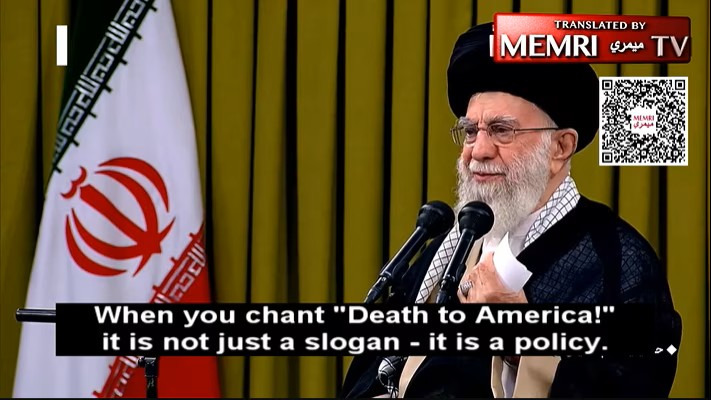
The Iranian regime, for instance, has for decades openly defined itself through hostility toward the United States and its allies. Its leaders have repeatedly chanted "Death to America" ("The Great Satan") and "Death to Israel" ("The Little Satan"), slogans that are not merely rhetorical flourishes but actual central elements of the regime's ideological identity. Iranian leaders, starting with the founder of the Islamic Republic, Ayatollah Ruhollah Khomeini, have openly called for the obliteration of Israel and have supported armed groups across the Middle East that target both Israelis and Americans.
Since 1984, the US government — under both Republican and Democrat administrations — has officially designated Iran as a State Sponsor of Terrorism for its support of terrorist organizations such as Hezbollah, Islamic Jihad, Hamas, and the Houthis; its involvement in attacks across the region and attempted attacks abroad, including involvement in the 9/11 attacks and at least two attempted assassinations on Trump, as well as targeting senior US officials for assasination in his first term.
Iran's regime has killed countless Americans, and continues to pursue policies designed to weaken American influence in the Middle East. It is a regime that has repeatedly demonstrated hostility toward the United States and its allies.
Yet when Trump took a hard stance against Tehran, instead of focusing on the nature of the Iranian regime itself, some critics appeared to focus exclusively on the identity of the president who was confronting it. The issue became less about Iran and more about Trump. His actions, rather than being evaluated on their merits, were filtered through the lens of political hostility. Whatever he does must be greeted with skepticism or condemned.
The hypocrisy is difficult to overlook. Many of the same political movements and advocacy groups that strongly emphasize women's rights and human rights have historically ignored Iran's state abuse of women and dissidents. For decades, Iranian authorities have imposed severe restrictions on women's freedoms, violently suppressed protests, and imprisoned journalists, activists, and political opponents. Tens of thousands of Iranians have been arrested, tortured, or murdered for challenging the regime's authority or for demanding basic freedoms.
Yet, when Trump confronts this very regime, the focus shifts away from the Iranian regime's actions and instead centers entirely on condemning Trump himself. The atrocities committed by the regime fade into the background.
Imagine how different the reaction might be under a different administration. Media coverage might emphasize Iran's human rights abuses, its repression of women, and its support for terrorist groups. Analysts would speak about defending human rights, protecting allies, and standing up to authoritarian governments. The policy would likely be framed as a necessary response to the brutal regime developing nuclear weapons and being a dangerous global threat.
When opposition to a political figure becomes absolute, every action that person takes must be opposed. The debate ceases to be about facts or moral principles and instead becomes a contest of political identity.
Critics who once spoke passionately about human rights abuses in Iran now appear unwilling to acknowledge them when doing so might align them with a policy pursued by Trump. Advocacy for women's rights, democracy, and freedom becomes selectively applied, filtered through the lens of domestic political rivalry.
In the end, the greatest danger of this mindset is not simply unfair criticism of a president. The deeper problem is that it weakens the ability of society to confront serious threats. When political hatred becomes so intense that it overrides basic judgment, it becomes difficult to distinguish between legitimate criticism and reflexive opposition. Perception of reality itself is broken.
At a moment when the world faces overwhelming security challenges – such as from China – currently developing new deadly pathogens for biowarfare and autonomous robots programmed to kill -- and authoritarian regimes that continue to threaten both their own populations and what they regard as their enemies -- denial and blindness carry serious risks.
Democracies function best when their debates are grounded in facts and reason rather than emotional reflexes. If political discourse becomes so polarized that people can no longer recognize the nature of regimes that repress their own citizens and openly threaten the United States and the Free World, the problem is far larger than any single president. It becomes a crisis that can only be addressed when people step outside their partisan bubbles and confront reality as it truly is.
Dr. Majid Rafizadeh, is a political scientist, Harvard-educated analyst, and board member of Harvard International Review. He has authored several books on the US foreign policy. He can be reached at dr.rafizadeh@post.harvard.edu
 cammo99