








No matter how many sanctions are imposed on the Islamic Republic of Iran, its regime continues to survive, adapt and expand its influence. This endurance is not the result of economic strength or internal legitimacy, but of a carefully constructed system designed to evade restrictions, exploit loopholes, and rely on foreign actors willing to ignore or undermine international enforcement.
As long as the Iranian regime can breathe through these openings, sanctions alone will not weaken it; instead, the regime will continue to fund repression at home, empower militant proxies abroad, and project dominance across the region.
At the heart of Iran's sanctions survival strategy is a clear understanding of global enforcement limits. The regime has learned that sanctions are only as effective as their implementation. Over time, the regime has institutionalized sanctions evasion, embedding it into state policy and delegating it to the Islamic Revolutionary Guard Corps (IRGC) and affiliated economic networks. This has turned evasion from an improvised response into a permanent survival machine.
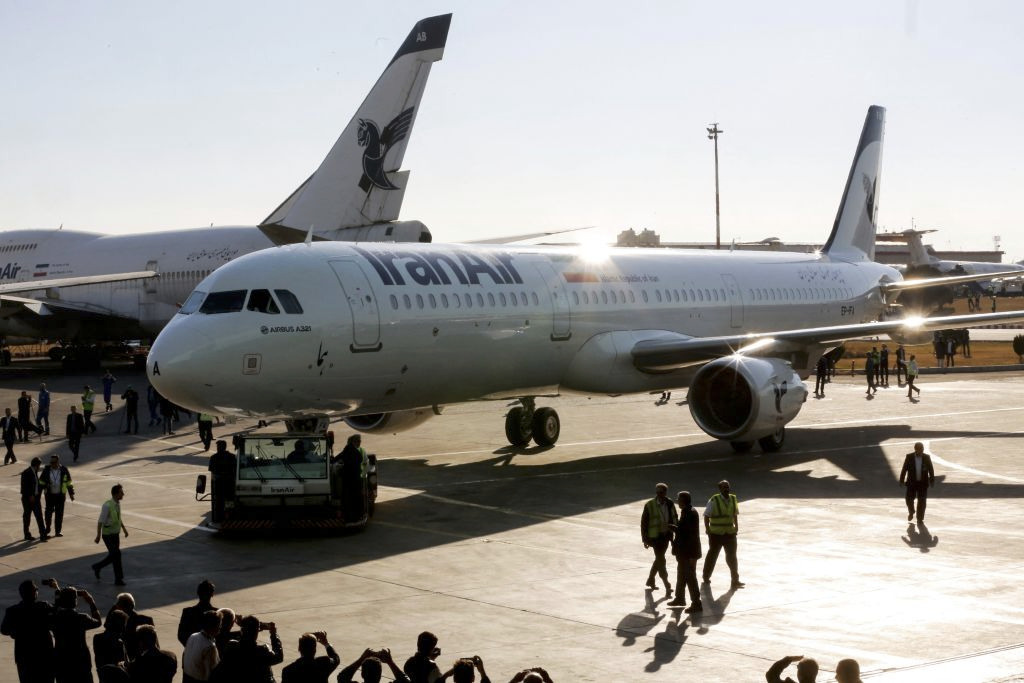
Iran's aviation sector is not merely civilian infrastructure but a strategic tool used to sustain the regime politically, economically, and militarily. Iranian airlines allow Tehran to move money, equipment, personnel, and goods across borders while bypassing traditional trade channels that are heavily sanctioned. Iran exploits gaps in international oversight to keep its fleets operating despite restrictions on aircraft sales, spare parts, insurance, and maintenance.
Iranian airlines also function through a web of front companies, falsified registrations, and indirect procurement networks. Aircraft parts and services that should be blocked under sanctions are often acquired through third parties, shell corporations, or intermediaries operating in countries with weak oversight or political sympathy toward Tehran.
Aviation is, in addition, crucial to Iran's external alliances, particularly with sanctioned or anti-Western regimes; Flights to countries such as Venezuela exemplify how Iran uses air routes not simply for commerce but for strategic cooperation among isolated states. These routes provide channels for the exchange of goods, expertise, and financial arrangements that, under sanctions, would otherwise be impossible. By maintaining these aviation links, the Iranian regime ensures that isolation is never absolute and that alternative geopolitical ecosystems remain open.
Beyond aviation, oil exports remain the single most critical source of income for Iran's regime. Even though sanctions are explicitly designed to cut off this revenue stream, Iran has repeatedly demonstrated that, without full global compliance, oil embargoes are only partially effective. Tehran has constructed a shadow oil economy that relies on concealment, mislabeling, ship-to-ship transfers, and complex logistics networks that disguise the true origin of its crude. Tankers, to obscure accountability, may sail with transponders turned off, change names and flags, or transfer oil at sea.
These practices succeed only because Iran has willing buyers. Iran's continued oil exports depend on countries that are prepared to ignore sanctions, interpret them loosely, or exploit enforcement gaps. The central role in this system is played by China, which purchases large volumes of discounted Iranian oil, assuring China of a steady flow of oil and Iran of a steady flow of cash. So long as demand exists, Iran will try to find ways to supply it.
Iran has also increasingly coordinated with other sanctioned or semi-isolated states, including Venezuela, to exchange crude oil, refine products, or share logistical infrastructure. In this parallel economic system, sanctioned regimes support one another, reducing the impact of Western pressure, undermining the value of sanctions as a deterrent and normalizing defiance of international norms.
Another core element of Iran's survival strategy is its extensive use of front companies and shell corporations, designed to conceal ownership, disguise transactions, and create plausible deniability for businesses and governments that interact with Iranian interests. Front companies often appear as legitimate trading firms, logistics providers, or financial intermediaries, but in reality are controlled directly or indirectly by the Iranian state or the IRGC. Through these structures -- frequently based in jurisdictions that offer secrecy, lax regulation, or political reluctance to confront Iran -- the regime conducts trade, secures financing, and moves money across borders with reduced visibility.
Iran's aviation industry uses similar corporate networks, which are instrumental in weapons smuggling and military procurement. Dual-use goods, missile components, drone technology, and conventional weapons are acquired through civilian trade channels that mask their final destination. Iran's ability to arm its proxies depends on these covert supply chains. They blur the line between economic activity and military logistics and enable the flow of weapons and technology.
To stop this cycle, sanctions enforcement must shift from symbolic -- fictitious -- pressure to the systematic suffocation of the Iranian regime. One of the most urgent steps is to focus aggressively on Iran's aviation sector. Grounding Iranian airlines would sever a key logistical lifeline for sanctions evasion and regional influence. This requires sanctioning not only Iranian carriers but also foreign companies and governments that provide aircraft parts, maintenance, insurance, fuel, and airport services. Without these inputs, Iran's aviation network cannot function.
Equally important is imposing consequences on countries and companies that enable Iran's oil exports. Sanctions must extend beyond Iranian entities to include buyers, refiners, shippers, insurers, and financial institutions that knowingly facilitate these transactions. Enforcement must be multinational, leaving no safe jurisdiction for intermediaries. If oil-sanctions evasion becomes costly and risky for buyers and service-providers, Iran's primary revenue source will shrink dramatically.
As long as the Iranian regime can evade sanctions, it will continue to strengthen and project power. Sanctions that are porous cannot seriously weaken the regime. To truly constrain Iran, the focus must shift to stopping the mechanisms that allow it to freely operate — its aviation network, oil exports, front companies, and all the regime partners that obligingly enable it.
Dr. Majid Rafizadeh, is a political scientist, Harvard-educated analyst, and board member of Harvard International Review. He has authored several books on the US foreign policy. He can be reached at dr.rafizadeh@post.harvard.edu
 Anne Wayne