








Since the end of Iran's 12-day war with Israel, there has been mounting evidence that its regime has been ramping up missile production. Tehran's perspective is straightforward: if its nuclear program has become more vulnerable, then its missile arsenal must increase as a compensatory tool of power.
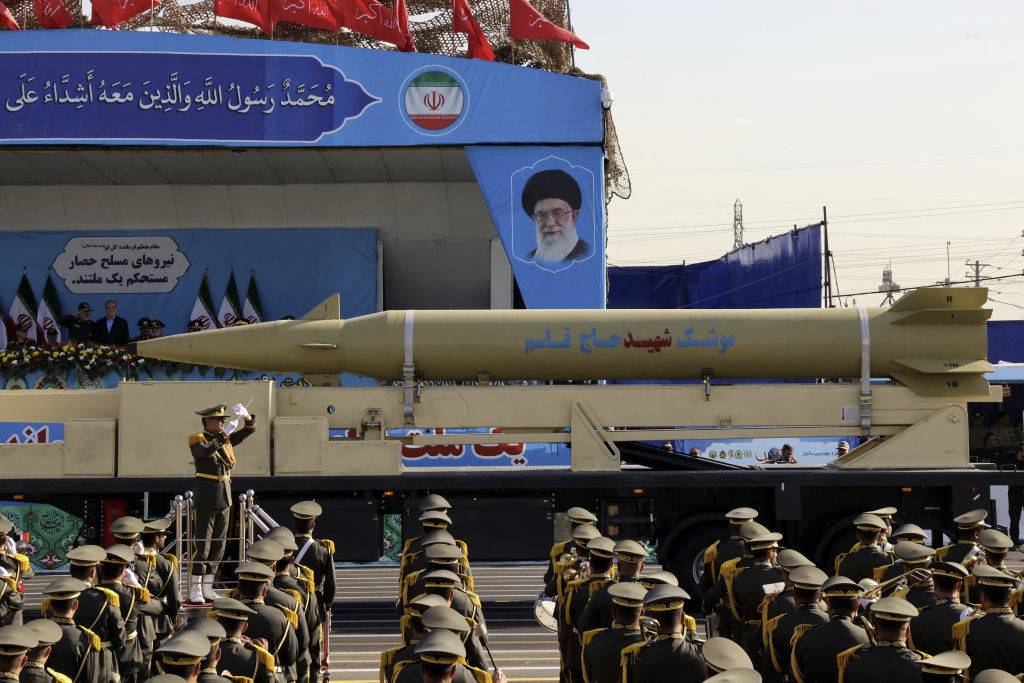
It is no secret that the Iranian regime has been accelerating and expanding its ballistic missile program at an alarming pace, and has invested heavily in improving the range, accuracy, survivability, and payload capacity of its missiles. These missiles – now part of reportedly the largest missile arsenal in the Middle East – can reach not only regional targets but also the U.S. and Europe, a senior Iranian lawmaker has openly boasted.
Such statements – far from rhetorical – appear part of a purposeful strategy of intimidation and coercion aimed at democracies and U.S. allies alike. While much global attention has understandably focused on Iran's nuclear ambitions, the regime's ballistic missile program has quietly emerged as its most immediate credible threat.
This trajectory should deeply concern the United States, Europe, and other democracies. A regime that openly calls for the destruction of Israel, supplies weapons to violent proxies, and supports Russia's war effort against Ukraine cannot be allowed to expand its missile capabilities unchecked.
It would be a mistake to conclude that because the 12-day war significantly damaged key elements of Iran's nuclear infrastructure, that the threat from the Iranian regime has therefore been neutralized. During that war, when Iran launched missiles at Israel, the mullahs used these weapons directly against civilians – most likely a war crime -- not at military targets.
Equally troubling is that over the years, Tehran has transferred missile systems, components, and technical expertise to its network of regional proxies and militias. Hezbollah in Lebanon, the Houthis in Yemen, and other armed groups aligned with Iran have all benefited from Iran's "beneficence." These weapons transfers have transformed local militias into strategic actors threatening international shipping lanes, civilian populations, and critical infrastructure far beyond their borders. Iran's missile program, therefore, is not just "defensive," as it claims. It is the backbone of a transnational strategy designed to destabilize the Middle East and challenge Western interests.
Iranian officials have repeatedly emphasized -- presumably to project power -- that their missiles can reach U.S. bases and European targets. When democracies respond to such threats with hesitation, they end up emboldening the behavior they are trying to prevent. Iran surely has learned over time that ambiguity and delayed responses often work in its favor, allowing it to advance its capabilities incrementally while avoiding disruptive consequences.
With the weapons it is supplying to Russia, Iran's drones and related technologies are already devastating Ukraine. This alone should dispel any illusion that Iran's ballistic missile program is a purely regional issue. It is a source of instability that now stretches from the Middle East to Eastern Europe, undermining international norms and fueling conflicts far beyond Iran's borders.
The Iranian regime today possesses the largest ballistic missile arsenal in the Middle East, and these missiles are central to its strategy of intimidation, proxy warfare, and regional domination. Even without a nuclear warhead, such weapons can alter strategic calculations across multiple regions. Ignoring this reality risks repeating past mistakes that allowed the problem to grow until the costs of action became far higher.
So, the question facing democracies is: Are we just going to sit and watch? If the answer is no, then the flow of funds sustaining the regime must be significantly curtailed, and sanctions targeting Iran's shipping networks, financial institutions, and procurement channels must be expanded and rigorously enforced.
As oil exports remain Tehran's primary source of revenue, the enforcement of existing sanctions—particularly on Chinese purchases of Iranian oil — have to become far more serious. Without sustained pressure on this revenue stream, Iran will continue to finance missile production, proxy warfare, and repression at home.
European governments must move beyond rhetorical concern and align their policies accordingly. Fragmented enforcement only creates loopholes that Iran exploits with remarkable efficiency.
The West must have a serious discussion—in close consultation with Israel, the United Arab Emirates and Morocco — about deterrence beyond sanctions. If Iran continues to expand its ballistic missile production and openly threatens other nations, policymakers must ask whether the same logic that justified action against nuclear infrastructure also applies to missile production capabilities. This is not a call for reckless escalation, but rather for credible consequences that convince Tehran its current stance carries unacceptable costs.
Iran uses its weapons directly, transfers them to militias, or leverages them to coerce and intimidate other nations. Increased sanctions, unified pressure, and a clear willingness to keep all options -- especially a military one -- on the table are not acts of aggression. They are measures of responsibility in the face of a growing and irrefutable threat.
Dr. Majid Rafizadeh, is a political scientist, Harvard-educated analyst, and board member of Harvard International Review. He has authored several books on the US foreign policy. He can be reached at dr.rafizadeh@post.harvard.edu
 Alan Rockman